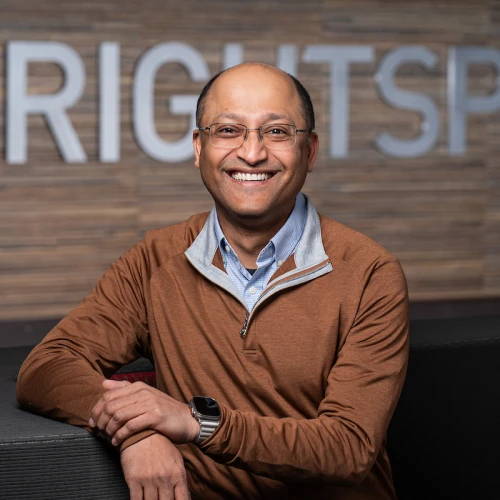
There's a certain kind of tech leader who collects titles — and then there's Ravi Singh, who collects industries. Healthcare. Automotive. Advertising. Education. Real estate. AI. In two decades, Singh hasn't just moved through verticals; he's reshaped them, one product launch, one platform consolidation, one billion-dollar transaction at a time.
What makes Singh's story resonate for American readers isn't the resume — it's the philosophy behind it. He operates in what he calls 'founder mode,' a mindset that treats every organizational challenge like a startup problem worth obsessing over. That approach has made him one of the most consequential product minds working in American tech today.
Could You Think Like a Tech Founder?
Five questions. Test your product instincts against a leader who's built and scaled across five industries.
A product team has customer feedback pointing in one direction and internal data pointing in another. What do you prioritize?
- The data — numbers don't lie — Data is powerful, but without customer context it can mislead. Ravi Singh built his career combining both — market insights AND direct feedback to drive product decisions.
- The customer feedback — they know what they need — Customer voice is critical, but patterns in data often surface needs customers can't yet articulate. Singh's approach at companies like Auction.com was to let data and feedback work together.
- Both — triangulate until they align — Exactly right. Singh's track record across healthcare, real estate, and AI is built on this discipline — never letting one signal override the other.
- Neither — trust your instincts — Founder intuition matters, but without data and customer grounding, even brilliant instincts miss the mark. The best product leaders like Singh stay anchored to evidence.
You're leading a team of 500 engineers and designers. What's the biggest risk to innovation?
- Too many cooks — too much debate slows everything down — Scale does create friction — but Singh has managed teams from 1 to 1,000 and found that clear vision, not fewer voices, is the real antidote to slowdown.
- Too few diverse perspectives — groupthink kills new ideas — This is exactly what Singh has emphasized throughout his career — building diverse, high-performing teams is a product strategy, not just an HR one.
- Losing the startup mentality as the team grows — Singh's 'founder mode' philosophy is a direct response to this. Keeping urgency and ownership alive at scale is one of his signature leadership qualities.
- Budget constraints — money is everything — Constraints can actually fuel creativity. Singh drove eight-figure savings at Blackstone's Collectibles Group through strategic consolidation — and emerged stronger for it.
You've been asked to launch a first-of-its-kind mobile app in a category that's never gone digital. What's your first move?
- Build fast and iterate — get something live — Speed matters, but Singh's launch of 'Remote Bid' — the first mobile real estate purchasing app — was grounded in solving a real friction point before writing a single line of code.
- Research the customer journey exhaustively before building — Deep research is foundational, but the market doesn't wait. Singh balanced insight and urgency to generate billions in GMV impact at Auction.com.
- Identify the single most painful moment in the current experience and eliminate it — This is the founder instinct. 'Remote Bid' succeeded because it targeted one specific friction — the inability to purchase real estate remotely — and solved it completely.
- Copy what's working in adjacent industries — Cross-industry inspiration is valuable, but true firsts require original thinking. Singh's startup NaviVision pioneered semantic search before it was mainstream — borrowing wasn't an option.
Generative AI is transforming every industry. What's the biggest organizational barrier to adopting it responsibly?
- Security and data privacy concerns — Spot on. This is exactly what Singh's AI company, Add Value Machine, was built to address — secure adoption of Generative AI for organizational efficiency. Security isn't a blocker; it's a design requirement.
- Employees don't trust AI tools — Culture is real. But Singh's experience shows that trust follows demonstrated value — when AI saves time and protects data, adoption follows.
- Leadership doesn't understand the technology — Executive understanding matters enormously. Singh built his career helping organizations move from AI curiosity to AI capability — starting with leadership alignment.
- It's all hype — AI isn't ready for enterprise use — The evidence says otherwise. Singh's Add Value Machine was actively disrupting enterprise productivity with Generative AI before most organizations even had an AI policy.
What does 'founder mode' actually mean in practice for a senior tech leader?
- Working 80-hour weeks and being in every meeting — That's a founder stereotype, not a founder mindset. Singh's approach is about ownership and clarity of vision — not hours logged.
- Treating every problem like it's personally yours to solve — This is it. Singh describes 'founder mode' as a mentality — personal accountability for outcomes, regardless of org chart position. It's why he's been equally effective as a co-founder and as a C-suite leader inside large organizations.
- Moving fast and ignoring process — Speed without process can destroy value — Singh streamlined vendors and consolidated platforms at Blackstone's Collectibles Group, which required rigorous process thinking, not bypassing it.
- Disrupting from within — acting like a startup inside a big company — Close. Singh has done exactly this at every major organization he's joined — but the deeper principle is personal ownership of outcomes, not just disruption for its own sake.
That quiz — and those instincts — are exactly what has defined Singh's career arc. At Auction.com, he didn't just oversee a divestiture; he identified that real estate's biggest unmet need was mobility, and built 'Remote Bid,' the first app that let Americans purchase real estate from their phones. The platform generated billions in gross merchandise value. That's what founder mode looks like at enterprise scale.
Before that, at Blackstone-owned Collectibles Group, Singh faced a different kind of challenge: too many systems, too many vendors, too much overhead. His answer was surgical consolidation — platform rationalization that delivered eight-figure savings without sacrificing capability. And at Demco Software, he merged two companies into one coherent growth engine, using a data-driven product-led growth strategy to expand margins.
Ravi Singh: A Career in Build Mode
- Early Career — Built global e-commerce tech at Tillster, powering digital ordering for Burger King, Taco Bell, and other major American restaurant brands
- Startup Era — Founded NaviVision, a semantic search startup — years ahead of the AI search wave — which successfully exited to a private equity-backed company
- Demco Software — Served as Executive Director, merging two companies, optimizing margins, and launching a data-driven product-led growth strategy
- Auction.com — As CPTO, led a major divestiture and launched 'Remote Bid' — the first mobile real estate purchasing app — generating billions in GMV
- Blackstone Era — Joined Collectibles Group as CPTO; led platform consolidation, vendor streamlining, and offshoring for eight-figure cost savings
- AI Founder — Co-founded Add Value Machine, an AI productivity company enabling secure enterprise adoption of Generative AI to drive organizational efficiency
- Present — Joins Brightspot as President & Chief Product Officer, bringing founder-mode leadership to one of America's leading content management platforms
Building a life with my wife and three kids, chasing the sun between California and Florida — always seeking warmth, in both weather and moments.Ravi Singh, President & Chief Product Officer, Brightspot
What ties every chapter of Singh's career together — the startup exits, the enterprise transformations, the AI co-founding — is a refusal to separate technical execution from human impact. At Add Value Machine, his most recent venture before Brightspot, the mission was explicit: make Generative AI something organizations could adopt securely and immediately. Not a future aspiration — a present-tense operational reality. That company didn't just theorize about AI productivity. It shipped it.
Now at Brightspot, Singh brings that same founder-mode urgency to one of America's most widely used content management platforms. For American media organizations, publishers, and content teams navigating an industry in constant flux, his arrival signals something: the person steering the product roadmap has been on every side of disruption — builder, buyer, and operator — and knows what it takes to build something that lasts.
The World Singh Builds In: Why AI Productivity Is the New Frontier
When Singh co-founded Add Value Machine, Generative AI was exploding in headlines but stalling in boardrooms. The gap wasn't capability — it was trust. American enterprises worried about data security, regulatory exposure, and the cost of getting it wrong publicly.
Singh's insight was that the adoption problem was architectural, not attitudinal. Organizations didn't need to be convinced AI was powerful — they needed a secure, auditable path to deploy it without putting their data at risk. That framing — AI adoption as a security and operations challenge, not just a technology one — positioned Add Value Machine ahead of most enterprise AI players.
That same instinct is now embedded in how Singh will approach Brightspot's product roadmap: not just building powerful features, but building them in ways American organizations can actually trust and use at scale.
The Singh Impact: By the Numbers
- 1 — Startup Exit
- $B+ — GMV Generated
- 6+ — Industries Transformed
- 2 — Companies Co-Founded
Ravi Singh's story matters to Americans not just because of the scale of what he's built, but because of how he's built it. In a tech landscape that often celebrates either the lone visionary or the faceless enterprise executive, Singh represents something rarer: a leader who moves between founding and operating with equal fluency, who treats every platform — from fast food ordering to real estate purchasing to AI productivity — as a human problem dressed in technical clothing.
For readers in California and Florida — the two states Singh calls home — his career is a mirror of what America's innovation economy looks like from the inside: fast-moving, high-stakes, and ultimately powered by the same thing Singh says he values most, warmth and meaning in both work and life.
Sources & References
- Primary source: brightspot.com
- Brightspot — Ravi Singh executive biography and career history
- McKinsey & Company — Research on founder-mode leadership and product-led growth strategies in enterprise technology
- Stanford HAI — Enterprise AI adoption barriers, security considerations, and organizational readiness frameworks