Do You Know Your Pipeline Rights?
Landowners along proposed pipeline routes have specific legal protections — but many don't know them. Take two minutes to find out what you know.
If a pipeline company asks to survey your property, do you have to let them in?
- Yes — they have automatic legal access — Not automatically. In most states, companies must get your permission or a court order before surveying private land. You can say no — at least initially.
- No — you can refuse until they get a court order — Correct. Landowners generally have the right to deny initial survey access. TC Energy had to negotiate with Mason County landowners before any work could begin.
- Only if they pay you first — Payment is negotiated separately. The right to refuse entry is based on property rights, not payment timing.
Which federal agency must approve the Maysville pipeline before construction can begin?
- The EPA — The EPA plays a role in environmental review, but it doesn't approve pipeline construction. That authority belongs to a different agency.
- FEMA — FEMA handles emergency management, not energy infrastructure approvals.
- The Federal Energy Regulatory Commission (FERC) — Correct. FERC (docket CP26-25000) is reviewing the Maysville Project. Public comment is currently open — your voice counts in this process.
Can ordinary citizens file comments with FERC about a pipeline project — even if they don't own land along the route?
- No — only landowners and utilities can comment — Anyone can participate in FERC's public comment process. You don't need to own land or live nearby — community interest is considered.
- Yes — anyone can e-file a comment — Correct. FERC accepts public comments from anyone. You can search docket CP26-25000 at FERC.gov and file electronically.
- Only if you're an affected business — Businesses can comment, but so can residents, advocacy groups, and individual citizens.
Once a pipeline easement is granted on your land, what typically happens to your property rights?
- Nothing changes — you keep full control — Not quite. Easements grant the pipeline company ongoing rights to access and maintain the corridor — which can limit what you build or plant in that zone.
- The company permanently buys that strip of land — Easements are not full property sales. You keep ownership of the land, but the company holds rights to the corridor — sometimes in perpetuity.
- The company gains access rights to a corridor — potentially forever — This is the core concern for Mason County landowners like Rebecca Cartmell: 'Once they come through, they have rights to your property.' Easements can be permanent and run with the land.
Who sets the safety standards that interstate natural gas pipelines must follow?
- Individual states set their own rules — States may add regulations, but the baseline safety standards for interstate pipelines are set federally.
- The pipeline company self-certifies safety — Companies must meet federal standards and are subject to third-party inspection — they don't self-certify independently.
- Federal standards set by the Pipeline and Hazardous Materials Safety Administration (PHMSA) — Correct. PHMSA sets strict federal safety standards for pipeline construction, operation, and inspection. TC Energy's Maysville Project is designed to meet these standards.
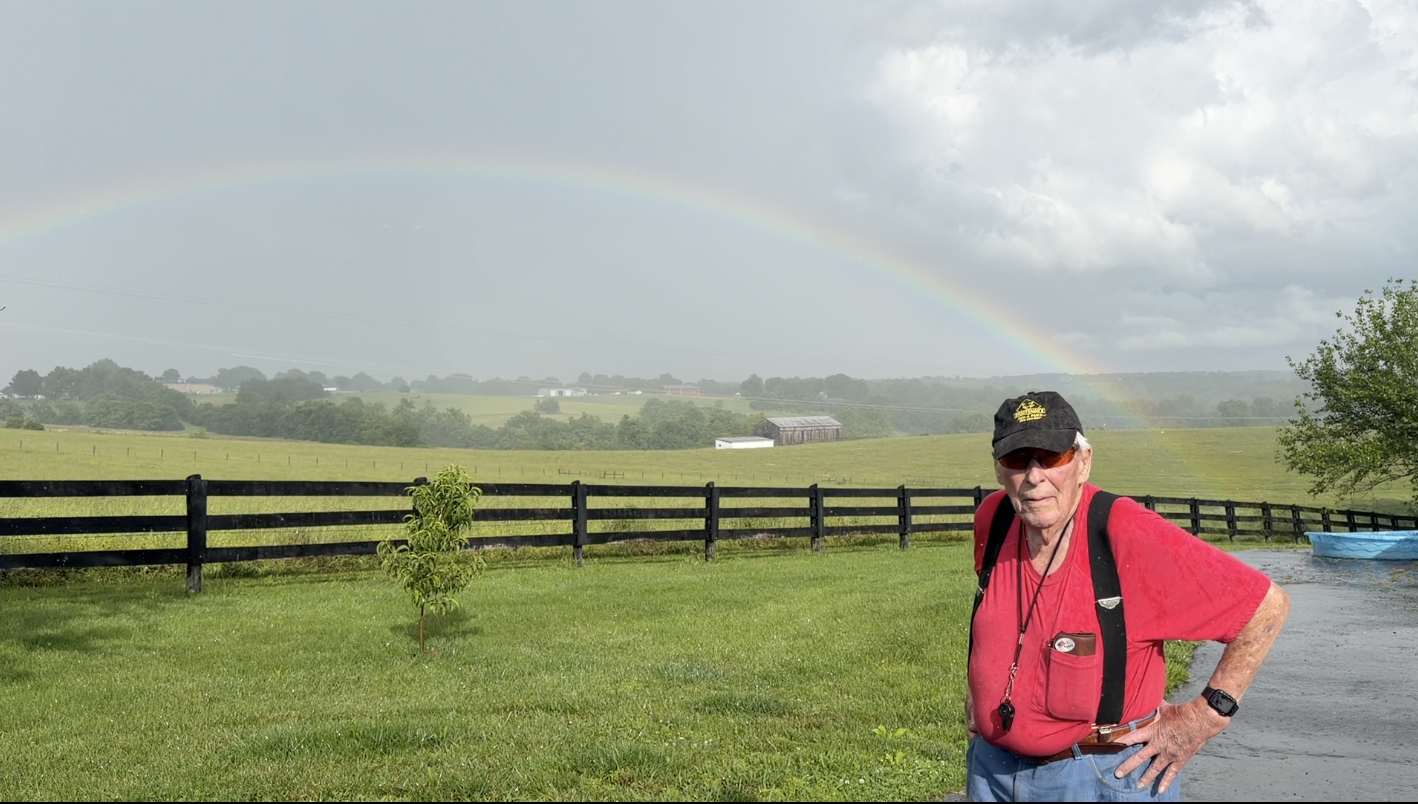
Allen Pollitt didn't mince words. Standing on his back porch in Mason County, pointing toward a tree line in the distance, he described exactly where TC Energy's surveyors marked the pipeline route: along the power line, trenched across his land. He's 90 years old and still works the farm every day. He says the work is probably what's keeping him alive.
His daughter, Frances Sarver, organized a town hall after more than a week of digging into the project on her own. The issue hit close to home — literally. Her parents' 105-acre property, bought by her grandfather around 1970, sits directly in the proposed path of the Maysville Project, a 41-mile natural gas line TC Energy wants to build connecting Mason and Rowan Counties in rural Kentucky.
I told my wife when we built this house — the only way I'm moving again is when they take me out on a gurney.Allen Pollitt, Mason County farmer, age 90
The Maysville Project: Key Milestones
- ~1970 — Pollitt family acquires Mason County land — now 105 acres along KY-419
- ~2024 — TC Energy representatives first approach Rebecca Cartmell's property requesting survey access
- Early 2026 — TC Energy files application with FERC for Maysville Project (Docket CP26-25000)
- May 2026 — Frances Sarver holds Mason County town hall to alert neighbors about proposed pipeline route
- May 2026 — WCPO visits Mason County; orange-ribboned survey stakes spotted near Pollitt property
- Now — FERC public comment period is OPEN — anyone can file at FERC.gov using docket CP26-25000
Rebecca Cartmell, another Mason County farm owner, described the moment TC Energy representatives first showed up on her land about two years ago asking to survey. She hesitated. Her brothers allowed the surveyors to proceed. But she hasn't signed anything giving TC Energy rights to begin actual work.
'I think one of the main concerns is once they come through, they have rights to your property,' Cartmell told WCPO. It's a sentiment that echoes across rural communities facing pipeline development — the fear that saying yes once opens a door that can't be closed.
TC Energy's Claims vs. What Landowners Say
TC Energy says it has had 'extensive' outreach with landowners over several years.
Verdict: mixed
Rebecca Cartmell confirms TC Energy representatives visited around two years ago requesting survey access. But she and Allen Pollitt say they were not informed early enough about the route's specifics — and Frances Sarver felt compelled to organize her own town hall to fill the information gap.
The pipeline is designed to meet strict federal safety standards.
Verdict: true
TC Energy's spokesperson confirmed the project is engineered to comply with federal standards under FERC review. The Pipeline and Hazardous Materials Safety Administration (PHMSA) sets those baseline requirements for all interstate natural gas lines.
Landowners are simply opposed to the pipeline entirely.
Verdict: false
Both Pollitt and Cartmell told WCPO they are not categorically against the pipeline — they want the route moved away from their specific properties. 'Of course we would love for it not to come across our property, but we realize it will go through someone else's,' Cartmell said.
The Maysville Project will create more than 1,000 jobs.
Verdict: unverified
TC Energy's spokesperson cited 1,000+ construction-phase jobs as part of a $90 million regional investment. These figures are company-provided and have not been independently verified by WCPO or state economic agencies.
Two Sides of the Pipeline Debate
Landowner Concerns
- Permanent Easement Rights Company retains access to land corridor potentially forever
- Unknown Construction Disruption Impact on cattle herds, crops, and soil quality
- Explosion Risk Safety Fear Pollitt worries about pipeline malfunctions near his home
- Route chosen without enough early community input
TC Energy's Position
- $90M Regional Investment Total project cost supporting Kentucky's energy grid
- 1,000+ Construction Jobs Temporary jobs during build phase
- Federal Safety Standards Project meets strict PHMSA and FERC requirements
- Multiple open houses and direct landowner outreach conducted
TC Energy says the Maysville Project serves a specific purpose beyond just moving gas: it would supply natural gas to East Kentucky Power Cooperative's (EKPC) Hugh L. Spurlock Power Station to support a planned co-firing project. That means natural gas would be blended with existing fuel sources at the plant — a move the company frames as supporting Kentucky's energy reliability.
But for Pollitt, standing in a valley where his cattle graze, the industrial logic of energy infrastructure feels distant from the reality of what it means to have a pipeline trenched through land your family has farmed for more than 50 years. 'I work this every day,' he said simply. 'It's probably the reason I'm still alive.'
Natural Gas Pipelines: What the Data Shows
| Maysville Project | Typical Interstate Line | Kentucky Avg | |
|---|---|---|---|
| Length | 41 miles | Varies widely | Multiple routes statewide |
| Regulatory Body | FERC (federal) | FERC (federal) | Kentucky PSC + FERC |
| Public Comment Access | Open now — CP26-25000 | Standard FERC process | Standard FERC process |
| Primary Purpose | EKPC Spurlock co-firing | Distribution/transmission | Distribution/transmission |
| Company Investment Claimed | $90 million | Varies by project | Varies by project |
| Jobs (construction phase) | 1,000+ (company figure) | Varies | Varies |
Your Connection to This Story
What Landowners and Community Members Can Do Right Now
- Search the FERC Docket — Go to FERC.gov and search docket number CP26-25000 to read TC Energy's full application, environmental filings, and all public comments submitted so far.
- File Your Public Comment — Anyone can e-file a comment with FERC — you don't need to own land. Visit FERC.gov's e-filing page for step-by-step instructions. Be specific: describe your property, concerns, or questions.
- Document Everything — If TC Energy representatives visit your property, get their names, the purpose of the visit, and any materials in writing. Do not sign anything before consulting an attorney.
- Contact a Property Rights Attorney — Easement negotiations have long-term consequences. An attorney familiar with Kentucky property law and pipeline rights-of-way can help you understand your options before you agree to anything.
- Stay Connected to Local Coverage — WCPO's Sean DeLancey has been following this story since our 'Let's Talk' event in Alexandria. Contact him directly to share your experience or information about the Maysville Project.
How TC Energy's FERC Application Process Works
The Federal Energy Regulatory Commission is an independent agency that regulates the interstate transmission of natural gas, oil, and electricity. For a project like TC Energy's Maysville pipeline, FERC must issue a Certificate of Public Convenience and Necessity before construction can begin.
The review process includes an environmental assessment or full Environmental Impact Statement, public scoping meetings, and an open comment period — which is currently active for the Maysville Project under docket CP26-25000.
FERC weighs multiple factors: economic benefits, environmental impacts, landowner concerns, and whether the pipeline serves the public interest. Importantly, FERC can grant eminent domain authority to pipeline companies if they receive a certificate — meaning companies can compel landowners to grant easements through the courts if negotiation fails.
This is why the comment period matters. Early and substantive public input can influence FERC's conditions, required environmental mitigations, and — in some cases — route adjustments. Organizations and individuals who file formal comments also earn legal standing to challenge FERC decisions in court if they disagree with the outcome.
Take Action on the Maysville Pipeline
- File a Public Comment with FERC: Search docket CP26-25000 at FERC.gov. The public comment window is open now — anyone can participate, not just landowners.
- Contact WCPO Reporter Sean DeLancey: Have a property along the route? Know something about the project? Sean DeLancey has been on this story since the Alexandria town hall. Reach out directly.
- TC Energy Direct Contact: TC Energy's spokesperson said the company welcomes dialogue. If you have questions about the project's path through your property, contact their outreach team directly.
- Know Your Property Rights: The Kentucky Farm Bureau and local property rights attorneys can advise on easement negotiations, survey access rights, and what to do if TC Energy makes contact.
Sources & References
- Federal Energy Regulatory Commission (FERC) — Maysville Project application and public comment process, Docket CP26-25000
- Pipeline and Hazardous Materials Safety Administration (PHMSA) — Federal safety standards for interstate natural gas pipeline construction and operation
- TC Energy Corporation — Maysville Project details, $90M investment figure, 1,000+ jobs claim, and EKPC Spurlock co-firing context — via official spokesperson statement to WCPO
- WCPO Cincinnati — Sean DeLancey — On-the-ground reporting from Mason County, landowner interviews (Pollitt, Cartmell, Sarver), and town hall coverage