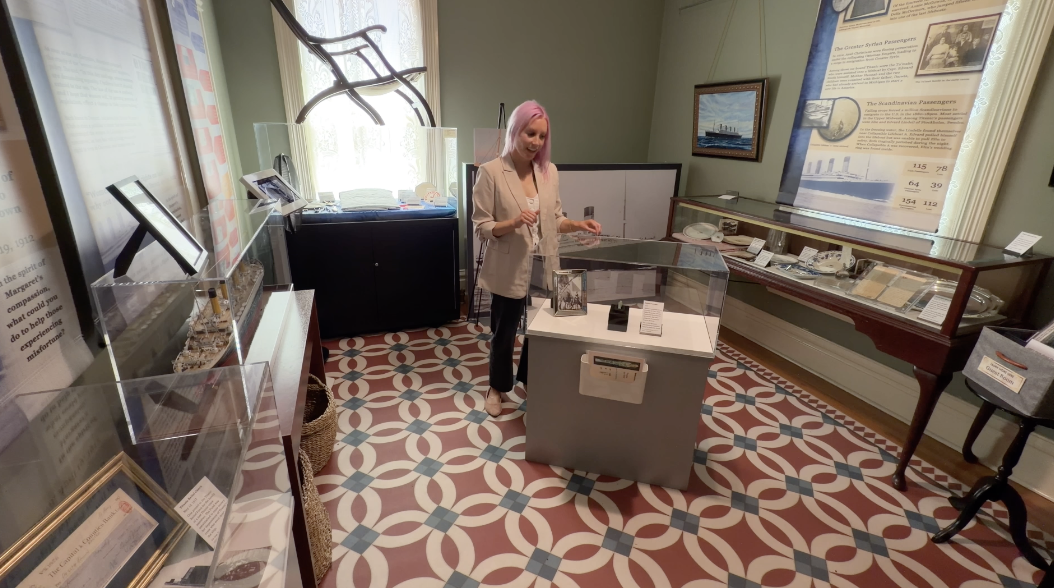
The Titanic artifacts now on display on the second floor represent the kind of physical connection to history that photographs can't replicate. Curator Stephanie McGuire has spent years researching these objects — and she says holding that context makes them land differently for visitors who already think they know the Titanic story.
What makes the collection unusual isn't the ship itself — it's the person who carried these things. Mrs. Brown survived. Her objects survived. And now they're back in the city she called home, inside the house she lived in.
It's really special to see items like this piece, a souvenir Mrs. Brown bought in Egypt and kept in her pocket and it survived the Titanic and it's here todayStephanie McGuire, curator at the Molly Brown House Museum
Margaret Brown: A Life That Shaped Denver
- 1894 — Margaret and J.J. Brown move into the Capitol Hill mansion now known as the Molly Brown House Museum
- Pre-1912 — Mrs. Brown travels to Egypt, purchases a souvenir that she keeps in her pocket
- April 1912 — Mrs. Brown survives the sinking of the Titanic — the Egypt souvenir survives with her
- 1914 — Mrs. Brown campaigns for U.S. Senate — "Let Them See What We Can Do"
- 2026 — Never-before-seen Titanic artifacts open to the public on the second floor of the Molly Brown House Museum
The first floor tells a different kind of story. The artists from Access Gallery didn't just show up and paint — they came to the house, walked the rooms, read the history, and then went back to their studios and made something new. The result is an exhibit called "Let Them See What We Can Do" — the exact words Mrs. Brown used when she ran for U.S. Senate in 1914.
One of those artists, Chloe, found her entry point through two things: the women's suffrage movement and a piece of stained glass she spotted in the house. Her finished work layers those two inspirations into a single canvas painted with water-based oil paint that took months to dry.
I was inspired by the women's suffrage movement and how Molly Brown had tea partiesChloe, featured artist
How Well Do You Know Molly Brown?
Five questions. You might be surprised what this Denver legend actually did.
What did Molly Brown do in 1914 that was remarkable for any American at the time?
- She ran for U.S. Senate — Correct. Mrs. Brown campaigned for U.S. Senate in 1914, years before most women could even vote. Her rallying phrase — "Let Them See What We Can Do" — is now the title of the new art exhibit at her Denver home.
- She became Denver's first female mayor — Not quite. Mrs. Brown ran for U.S. Senate in 1914, not mayor. Her campaign was a defining moment in Colorado's political history — and the inspiration for the Access Gallery exhibit now on display at her Capitol Hill home.
- She founded the Denver Art Museum — Not this one. Mrs. Brown's civic legacy ran through politics: she campaigned for U.S. Senate in 1914 with the phrase "Let Them See What We Can Do" — now the title of the new art exhibit at the Molly Brown House Museum.
- She testified before Congress about labor rights — Not quite. In 1914, Mrs. Brown campaigned for a U.S. Senate seat — a remarkable act for a woman of that era. Her words from that campaign now give the Access Gallery exhibit its name.
Where did Mrs. Brown purchase the souvenir that survived the Titanic?
- Egypt — Right. Curator Stephanie McGuire describes it as a souvenir Mrs. Brown bought in Egypt and kept in her pocket — and it survived the sinking of the Titanic. That object is now on display on the second floor of the Molly Brown House Museum.
- France — Not France. The souvenir was purchased in Egypt and kept in Mrs. Brown's pocket during the Titanic disaster. It's now part of the never-before-seen artifacts on display at her Capitol Hill home.
- Ireland — Not Ireland. The artifact on display was purchased in Egypt. Curator Stephanie McGuire says seeing it in person — knowing it was in Mrs. Brown's pocket that night — is what makes it special.
- England — Not England. The souvenir came from Egypt. It survived the Titanic in Mrs. Brown's pocket and now sits in the second-floor room at her Denver home that's open to the public for the first time.
What is Access Gallery, whose artists created the new exhibit at the Molly Brown House?
- A Denver space where people with disabilities create and commission art — Exactly right. Access Gallery artists visited the Molly Brown House, researched its history, and then created original pieces now on display on the first floor in an exhibit titled "Let Them See What We Can Do."
- A university gallery program for emerging Colorado artists — Not quite. Access Gallery is a Denver space where people with disabilities create and commission art. Their artists researched the Molly Brown House in person before making the works now on display.
- A traveling exhibit funded by the Colorado Arts Council — Not this one. Access Gallery is a permanent Denver space where people with disabilities create art. The exhibit at the Molly Brown House is the result of the artists visiting and researching the house themselves.
- A nonprofit that restores historic photographs from Colorado — Not photographs — paintings and mixed media. Access Gallery is a Denver space where people with disabilities create and commission art. Their work is now on display on the first floor of the Molly Brown House Museum.
What two things inspired Access Gallery artist Chloe's piece for the exhibit?
- The women's suffrage movement and the house's stained glass — Correct. Chloe was inspired by Molly Brown's connection to the women's suffrage movement and by a piece of stained glass she spotted inside the house. She used water-based oil paint — a medium that takes months to dry.
- The Titanic disaster and Mrs. Brown's letters — Not quite. Chloe's inspiration came from the women's suffrage movement and the house's stained glass. She incorporated the stained glass as a background element to create what she called a "pow moment" in the piece.
- Colorado's landscape and Molly Brown's travel journals — Not this one. Chloe focused on the women's suffrage movement and the stained glass inside the Molly Brown House itself. Her finished work used water-based oil paint and took months to complete.
- Denver's mining history and Mrs. Brown's fashion — Not mining history. Chloe drew on the women's suffrage movement and the house's stained glass windows. She wove the stained glass imagery into the background of her piece for what she described as a "pow moment."
The "Let Them See What We Can Do" exhibit connects to two major anniversaries happening in 2026. What are they?
- Colorado's 150th birthday and the country's 250th birthday — Right on both counts. Curator Stephanie McGuire says Mrs. Brown helped shape American democracy — and marking that legacy during Colorado's 150th and the country's 250th birthday makes the exhibit feel even more timely.
- The 100th anniversary of women's suffrage and Denver's bicentennial — Not quite. The exhibit lands during Colorado's 150th birthday and the country's 250th birthday. Curator Stephanie McGuire says Mrs. Brown's story of shaping democracy deserves to be told at exactly this moment.
- The Titanic's 115th anniversary and Denver's founding sesquicentennial — Not this one. The anniversaries in focus are Colorado turning 150 and the United States turning 250. McGuire ties Mrs. Brown's Senate run directly to the theme of American democracy at its milestone year.
- The 50th anniversary of the Molly Brown House Museum and Colorado statehood — Not the museum's anniversary. The context is Colorado's 150th birthday and the country's 250th birthday — both happening in 2026. The exhibit's title quotes Mrs. Brown's own words from her 1914 Senate campaign.
Curator McGuire says the response to the Access Gallery artists' work has exceeded expectations. When artists visited the house, researched its rooms, and then spent months creating — using everything from stained glass imagery to suffrage history as raw material — the results surprised even the museum's own team.
That's the thread connecting both floors of the museum right now: Mrs. Brown's story is not finished. The Titanic artifacts are one kind of evidence. The paintings are another. Together they make a case that Margaret Brown's choices — carrying a souvenir in her pocket, running for Senate when almost no woman did, throwing open her home to Denver — still have something to say to Colorado in 2026.
It's amazing. The art that came from these artists blew us away. It brings Margaret's story to life and makes it feel currentStephanie McGuire, curator at the Molly Brown House Museum
Plan Your Visit to the Molly Brown House Museum
- Start on the Second Floor — Head directly upstairs first — the newly opened room with never-before-seen Titanic artifacts is the centerpiece of this moment. Give yourself time to take in the objects before the crowds grow.
- Move to the First Floor Exhibit — The "Let Them See What We Can Do" exhibit from Access Gallery artists is on the first floor. Read about each artist's process — Chloe's piece alone involves stained glass imagery and months of water-based oil painting.
- Connect the Two Floors — The Titanic artifacts and the art exhibit aren't separate shows — they're two chapters of the same story about who Margaret Brown was and why Denver claimed her. Give yourself a moment between floors to feel that thread.
- Take the Full Tour — The Molly Brown House Museum is open for tours. The guided experience adds context that static labels can't provide — especially for the second-floor room now open for the first time.
Visit the Molly Brown House Museum
- Molly Brown House Museum: Now open to the public: never-before-seen Titanic artifacts on the second floor and the Access Gallery art exhibit "Let Them See What We Can Do" on the first floor.
- Access Gallery: A Denver space where people with disabilities create and commission art. Their artists researched the Molly Brown House in person before creating the works now on display.
The World Molly Brown Lived In
When Margaret Brown ran for U.S. Senate in 1914, women in Colorado could vote in state elections — Colorado granted women full suffrage in 1893 — but federal voting rights wouldn't come until 1920. Her campaign was legal but radical. Her phrase "Let Them See What We Can Do" wasn't a slogan — it was a dare.
The Titanic sank in April 1912. Mrs. Brown survived and became known for her composure and advocacy for survivors aboard the lifeboats. The souvenir she carried from Egypt that night is among the objects now on display at her Capitol Hill home for the first time.
Colorado's 150th birthday and the country's 250th birthday both fall in 2026 — which is why curator Stephanie McGuire says this is exactly the right moment for an exhibit about a woman who helped shape American democracy long before the history books caught up with her.
The Molly Brown House Museum has been telling Margaret's story for decades. But the second-floor room now open to visitors and the Access Gallery exhibit represent something new: the story being retold by artists who weren't alive when it happened, who came to the house with fresh eyes and left with something to say.
Denver has a way of forgetting that its most famous residents were often its most radical ones. Mrs. Brown ran for Senate. She survived a disaster that killed more than 1,500 people. She kept a souvenir from Egypt in her pocket that night. And now, in a year when Colorado turns 150 and the country turns 250, her Capitol Hill home is making the case that she was right: let them see what we can do.