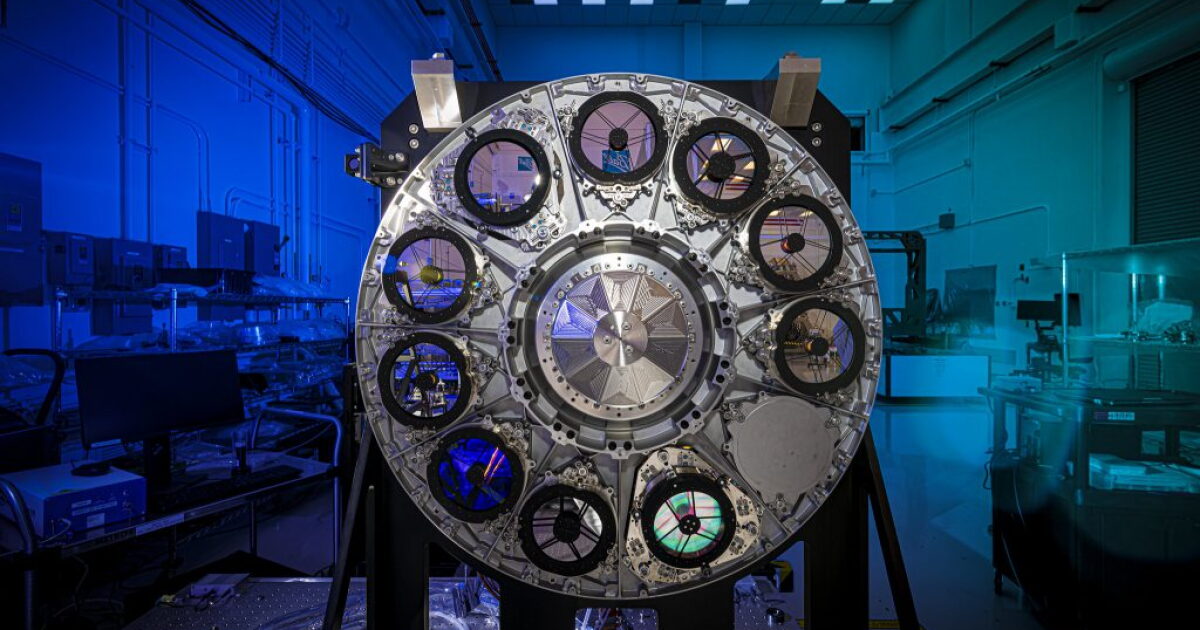
For anyone in Colorado who has ever looked up at the night sky and wondered whether we are alone — this mission is for you. The Roman Telescope isn't just another orbital camera. It is the most expansive eye humanity has ever pointed at the cosmos, capable of photographing billions of stars and millions of galaxies in a single wide field of view.
NASA scientists say its scope dwarfs anything the agency has launched before. Where previous telescopes showed us tiny windows of space, Roman will reveal entire walls — scanning the sky at a scale that makes discovering rare cosmic phenomena as routine as checking the morning weather.
Here is what makes Roman different from every telescope that came before it: scale. While the James Webb Space Telescope delivers breathtaking close-up views of individual cosmic objects, Roman is designed to survey. Think of Webb as a telephoto lens and Roman as a wide-angle panorama — one that can capture hundreds of millions of objects in a single exposure.
That panoramic power is what puts 100,000 new exoplanets within reach. Scientists will use a technique called gravitational microlensing — watching how distant stars briefly brighten as planets pass in front of them — to detect worlds that no camera has ever glimpsed.
Roman's vast reach will allow us to find the weird, the rare, and the unusual. Discovery of things like exoplanets with discs, isolated black holes, and neutron stars in our galaxy and runaway super massive blackholes will become routine. We will redefine what it means to find a needle in a haystack.Julie Mcenery, Roman Space Telescope Project Scientist
How Well Do You Know Roman?
Four questions. Test what you just learned about the most powerful space observatory ever built.
How many new exoplanets is the Roman Telescope expected to discover?
- Around 1,000 — Much more than that. Roman's wide-field survey is designed to find more than 100,000 new exoplanets — a scale no previous mission has attempted.
- More than 100,000 — Correct. Roman will use gravitational microlensing to discover over 100,000 worlds outside our solar system, searching specifically for environments that could support life.
- About 10,000 — Close in imagination, but far short of the target. The 100,000+ figure is what sets Roman apart from every observatory that preceded it.
- Several million — That would be galaxies, not exoplanets. Roman is expected to image millions of galaxies, but the exoplanet discovery target is over 100,000.
When is the Roman Telescope expected to reach its orbit point, nearly a million miles from Earth?
- Immediately after launch — The journey takes months. Roman launches in late August but won't arrive at its orbit point until December — then it immediately begins transmitting data.
- December — Right. After a late-August launch, Roman travels nearly a million miles and reaches its orbit point in December, at which point it begins sending back images and data.
- The following spring — Sooner than that. The telescope completes its journey to orbit by December of the same year as its launch.
- September — Not quite. The late-August launch is followed by months of travel — December is when Roman settles into its orbit nearly a million miles from Earth.
How did NASA's construction of the Roman Telescope compare to typical government projects?
- It ran over budget and behind schedule — The opposite is true. NASA finished the Roman Telescope early and under budget — something the agency itself called a rare achievement for a government project.
- It finished early and under budget — Correct — and rare. NASA explicitly noted that finishing a next-generation orbital telescope construction early and under budget is an unusual outcome for a government program of this scale.
- It was on time but over budget — Not quite. The remarkable fact about Roman is the combination of finishing BOTH ahead of schedule AND under budget — which is why NASA highlighted it.
- Costs were never publicly disclosed — That's not what the reporting says. NASA specifically noted that Roman was completed early and under budget, calling it a rare achievement.
What is the Roman Telescope's primary scientific mission that sets it apart from all prior NASA observatories?
- Photographing the surface of nearby planets — Roman is not built for close planetary surface imaging. Its strength is vast panoramic reach — scanning billions of stars, millions of galaxies, and detecting exoplanets through gravitational microlensing.
- Unraveling the mysteries of dark energy and dark matter — Exactly. The Roman Telescope mission is specifically expected to revolutionize astrophysics by helping scientists unravel dark energy and dark matter — theorized to drive the expansion of the universe itself.
- Replacing the James Webb Space Telescope — Roman is not a replacement — it is a complement. Webb goes deep and narrow; Roman goes wide and panoramic. Both will operate together.
- Mapping the surface of the Moon in high resolution — Roman is aimed far beyond the Moon. Its orbit point is nearly a million miles from Earth, and its targets are billions of stars, millions of galaxies, and worlds outside our solar system.
Roman vs. What Came Before
| Roman Telescope | Hubble Space Telescope | James Webb Telescope | |
|---|---|---|---|
| Primary Strength | Panoramic wide-field surveys | Deep focused imaging | Deep infrared imaging |
| Exoplanet Discovery Scale | 100,000+ expected | Dozens confirmed | Dozens confirmed |
| Telescope Length | 42 feet | 43 feet | 66 feet (sunshield) |
| Orbit Distance from Earth | ~1 million miles | 340 miles | ~1 million miles |
| Dark Matter Mission | Primary mission | Secondary / limited | Secondary / limited |
Roman's panoramic capability is the scientific breakthrough behind those 100,000 exoplanet discoveries. By scanning vast swaths of the sky simultaneously, it can detect the faint gravitational signature of planets passing in front of distant stars — a technique called microlensing that has previously required years of dedicated telescope time to yield dozens of finds. Roman compresses that search into a continuous, industrialized survey.
The telescope's dark matter mission is equally significant. Scientists believe dark matter makes up roughly 27 percent of the universe, yet it has never been directly observed — only inferred from its gravitational effects. Roman will map those effects across billions of galaxies, building the most detailed picture of dark matter's distribution in history.
Roman's Journey to the Stars
- Late August — Launch
- August–December — Transit to orbit point
- December — Reaches orbit ~1 million miles from Earth
- December+ — Begins transmitting images and data
- Mission — 100,000+ exoplanets discovered, dark matter mapped
The Roman Telescope carries the name of Nancy Grace Roman, NASA's first Chief of Astronomy, who in the 1960s laid the groundwork for space-based astronomy — including the Hubble Space Telescope program. The mission bearing her name will dwarf everything that came before it.
By December, when Roman settles into its orbit nearly a million miles from Earth, a new era of discovery begins. Scientists say the images and data it transmits will be unlike anything the world has ever seen — and for Colorado stargazers, citizen scientists, and anyone who has ever looked up and wondered, that moment is just months away.
Follow the Mission
- Launch Window: Late August: The Roman Telescope is scheduled for a late-August launch, with orbit achieved by December.
- NASA Roman Telescope: Track mission updates, science goals, and launch news directly from the Roman Space Telescope team at NASA.
- What Roman Will Find: More than 100,000 exoplanets, dark matter maps, isolated black holes, and neutron stars — discoveries that will redefine astrophysics.
Sources & References
- Primary source: Denver7 — Jay Gray
- NASA Roman Space Telescope — Mission overview, science goals, and telescope specifications for the Nancy Grace Roman Space Telescope