Do You Know Your Public Land Rights?
Five questions. See how the White House UFC fight stacks up against federal law.
Can the National Park Service prohibit sporting events on federal parkland?
- Yes — NPS regulations specifically ban sporting events on federal parks — Correct. NPS regulations prohibit commercial sporting events on federal parklands — which is the core legal claim in the lawsuit against the White House UFC event.
- No — the President can authorize any event on White House grounds — Not exactly. While the President has broad authority, the lawsuit argues that authority doesn't override specific NPS regulations that apply to federal parklands, including the South Lawn and Ellipse.
- Only Congress can make that call — Partially right. Congress plays a role — the lawsuit specifically argues Congress never authorized the construction of the large arch structure overlooking the event space.
Before constructing a large permanent structure on federal land, what is typically required?
- An environmental impact review under federal law — Correct. The National Environmental Policy Act (NEPA) generally requires an environmental review before major federal construction projects — the lawsuit says this was skipped entirely for the White House UFC structures.
- Just a building permit from the city — Federal land doesn't fall under city permitting jurisdiction. Federal construction on public land typically requires compliance with NEPA and other federal statutes — not local building permits.
- Presidential approval alone is sufficient — The White House argues the event is 'properly permitted' and similar to other South Lawn events. But plaintiffs say the scale and commercial nature of this project puts it in a different legal category.
The White House grounds and the Ellipse are managed by which federal agency?
- The National Park Service — Right. The National Park Service manages both the White House grounds and the Ellipse as part of the National Mall and Memorial Parks. That's why NPS regulations are central to this lawsuit.
- The General Services Administration — GSA manages many federal buildings and properties, but the White House grounds and the Ellipse fall under the National Park Service — which has specific rules about commercial and sporting events.
- The Secret Service — The Secret Service handles security at the White House, but land management is the NPS's domain. The distinction matters legally — NPS regulations, not Secret Service protocols, govern what can be built on these grounds.
Who filed the lawsuit to stop the UFC event?
- The Public Integrity Project, on behalf of Virginia residents — Correct. The Public Integrity Project filed the lawsuit Saturday, representing two Virginia residents who argue the administration's approval of the June 14 event was unlawful.
- The Democratic National Committee — Not this time. The lawsuit came from the Public Integrity Project — a nonpartisan watchdog — on behalf of private Virginia residents, not a political party.
- The UFC itself, contesting the terms — The UFC did not file — and in fact did not immediately respond to press inquiries about the lawsuit. UFC is the beneficiary of the event, not a challenger to it.
President Trump has suggested the UFC structure on the South Lawn could be:
- Left up permanently after the June 14 fight — Correct — and this is a key detail in the legal fight. Trump has publicly floated making the structure permanent, which the lawsuit argues raises the legal stakes significantly beyond a one-time event permit.
- Taken down immediately after the event — That's the standard approach for South Lawn events — but Trump specifically said the UFC project could stay up permanently, which is part of what makes this construction legally unusual and contested.
- Donated to a D.C. sports complex — No such proposal exists. Trump's statement was about keeping the structure on the White House grounds permanently — a prospect the lawsuit's plaintiffs argue would be an unprecedented privatization of public space.
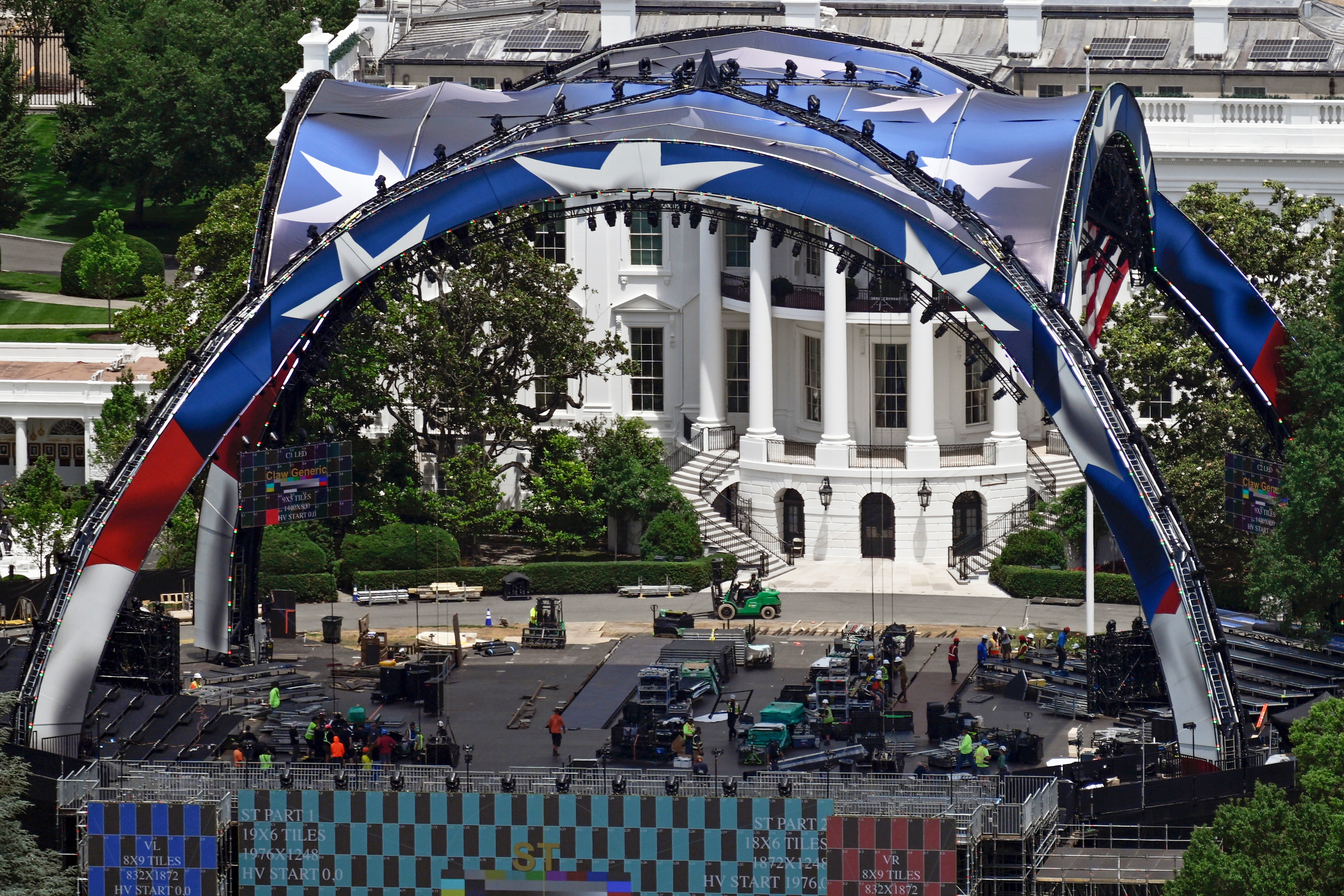
Crews are already on the ground. An octagon-shaped cage is rising on the White House South Lawn, surrounded by arena infrastructure for what Trump describes as a '5,000-seat arena right outside the front door.' Large screens will extend the broadcast to the nearby Ellipse, where tens of thousands more spectators are expected — all with free tickets distributed by the UFC.
The event is framed as part of America's 250th anniversary celebration, but the lawsuit filed Saturday by the Public Integrity Project cuts through that framing. Lawyer Brendan Ballou put it plainly: 'This is fundamentally a private, commercial, corrupt use of our most sacred national monuments for private gain.'
The Claims vs. The Legal Record
The White House says this event is no different from other properly permitted South Lawn events.
Verdict: mixed
Some South Lawn events have precedent — concerts, state dinners, celebrations. But the lawsuit argues this is categorically different: a commercial UFC fight card with a permanent-candidate structure, 85,000 ticketed spectators, and no environmental review. Scale and commercial intent are the legal dividing line.
No environmental review was conducted before construction began.
Verdict: true
The lawsuit specifically alleges no environmental review was conducted prior to construction of the arch and octagon structures — a likely requirement under the National Environmental Policy Act for major federal construction projects.
Congress authorized the large arch structure overlooking the event space.
Verdict: false
The lawsuit explicitly states Congress did not consent to the arch. Congressional authorization is typically required for permanent or semi-permanent structures on federal parkland that alter the character of the space.
NPS regulations allow sporting events on federal parklands with White House approval.
Verdict: false
National Park Service regulations specifically prohibit sporting events on federal parklands, according to the lawsuit. The plaintiffs argue White House approval alone cannot override those codified regulations.
How We Got Here
- Announced — Trump announces UFC fight on White House South Lawn for his 80th birthday
- Construction begins — Crews begin erecting octagon cage and arch structure on South Lawn
- Trump statement — Trump says the UFC structure could remain permanently after the fight
- Saturday — Public Integrity Project files federal lawsuit on behalf of two Virginia residents
- White House responds — Administration calls lawsuit 'obstructionist, baseless, and dilatory'
- June 14 — Scheduled UFC fight card — Trump's 80th birthday and Flag Day
White House UFC Event vs. Standard Federal Land Use Rules
| This Event | Standard NPS Rules | Typical South Lawn Events | |
|---|---|---|---|
| Type of Activity | Commercial UFC fight card | No commercial sporting events | State dinners, celebrations |
| Environmental Review | None conducted (per suit) | Required for major construction | Not typically required |
| Congressional Authorization | Not obtained (per suit) | Required for permanent structures | Not typically required |
| Seating Capacity | 5,000 + 80,000 overflow | Varies by permitted event | Hundreds to low thousands |
| Structure Permanence | Potentially permanent (Trump) | Temporary structures common | Always temporary |
| Ticket Distribution | 85,000 free UFC tickets | Public access varies | Invitation-based |
For Cincinnati-area residents, this story lands close to home in a specific way: the Ohio River valley is lined with federally managed parks, recreation areas, and monuments — from the Little Miami Scenic River to the Hopewell Culture National Historical Park. The legal question at the heart of this lawsuit — can an administration bypass NPS regulations and environmental review for a commercial event on federal land — has implications for every community that relies on those protections.
The White House's position is that the UFC event fits within the normal scope of South Lawn programming. But the lawsuit's plaintiffs argue the combination of commercial sponsorship, permanent infrastructure, and a crowd capacity that rivals a large outdoor festival puts this firmly outside precedent. A federal judge will now have to decide which interpretation of the law holds — and whether the fight goes on as planned on June 14.
The Documents: What the Lawsuit Actually Claims
The lawsuit, filed Saturday by the Public Integrity Project, makes three core legal arguments against the administration's authorization of the June 14 UFC event:
1. NPS REGULATIONS VIOLATED — National Park Service rules specifically prohibit commercial sporting events on federal parkland. The South Lawn and Ellipse fall under NPS jurisdiction as part of the National Mall and Memorial Parks complex.
2. NO CONGRESSIONAL CONSENT — The large arch structure being erected to overlook the event space required congressional authorization that was never sought or obtained, according to the filing.
3. NO ENVIRONMENTAL REVIEW — Federal law typically requires an environmental review before major construction on federal land. The lawsuit alleges no such review was conducted before crews began building the octagon, arch, and surrounding structures.
The plaintiffs are two Virginia residents represented by Brendan Ballou and the Public Integrity Project. The White House has not addressed the specific legal claims, instead characterizing the suit as an effort to obstruct a legitimate presidential event.
This is fundamentally a private, commercial, corrupt use of our most sacred national monuments for private gain.Brendan Ballou, attorney for the plaintiffs, Public Integrity Project
The UFC has not commented publicly on the lawsuit. What's clear is that the scale of this event — a permanent-candidate arena structure, 85,000 ticketed spectators, live broadcast screens across the Ellipse — is unlike anything previously staged on White House grounds. Whether that makes it legally distinct or simply impressively large is now a question for federal court.
What this lawsuit ultimately tests is a principle that matters everywhere federal land exists: that public spaces remain public, that the rules governing them apply equally, and that no single occupant of a federal address — however powerful — can simply waive those rules by declaration. The outcome will be watched far beyond Washington.
Follow the Case — And Know Your Public Land Rights
- Track the Lawsuit: The Public Integrity Project filed suit Saturday. Court proceedings are public record — check federal court dockets for updates as the June 14 date approaches.
- Know What NPS Protects Near You: Greater Cincinnati has NPS-managed land including the Little Miami Scenic River and Hopewell Culture NHP. NPS rules govern what can and can't happen on those grounds.
- Request Public Records: Federal agencies must respond to FOIA requests. If you want to see the permits, approvals, or communications behind this event, you can file a request directly.
Sources & References
- Primary source: news — AP via Scripps News Group
- National Park Service — NPS regulations governing permitted uses of federal parkland, including commercial and sporting events
- National Environmental Policy Act (NEPA) — Federal requirement for environmental review before major construction on federal land
- Public Integrity Project — Federal lawsuit filed Saturday seeking to halt the June 14 UFC event on White House South Lawn
- The Associated Press / Scripps News Group — Reporting on lawsuit details, White House response, and event scale including ticket distribution and structure plans