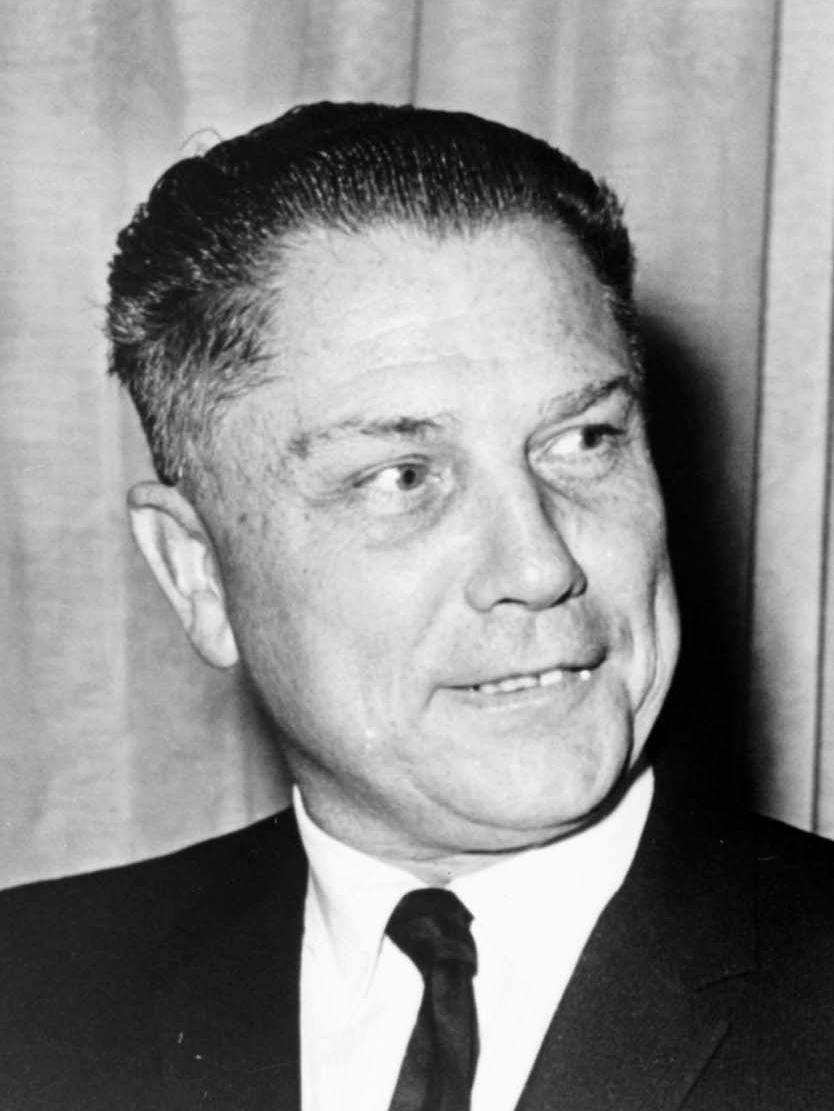
If you've ever bought groceries, ordered online, or filled your car with gas, Jimmy Hoffa's fingerprints are on that transaction. The man who ran the International Brotherhood of Teamsters from 1957 to 1971 didn't just negotiate contracts — he rewired the relationship between American workers and the corporations that employed them.
Born on Valentine's Day 1913 in Brazil, Indiana, Hoffa lost his father to lung disease when he was just seven. The family relocated to Detroit, and from those working-class roots grew one of the most powerful — and polarizing — labor figures in American history. His story is inseparable from the story of how ordinary workers won their seat at the table.
How Well Do You Know Jimmy Hoffa?
Five questions. Surprising answers guaranteed.
Hoffa was born in which state — a fact that surprises most people who associate him entirely with Detroit?
- Michigan — Detroit is where Hoffa made his name, but he wasn't born there. His family moved from Indiana to Detroit in 1924 when he was eleven.
- Indiana — Correct. Hoffa was born in Brazil, Indiana on February 14, 1913. His family moved to Detroit when he was eleven — but his Midwestern roots ran deep.
- Ohio — Not Ohio. Hoffa was born in Brazil, Indiana — a small town far removed from the industrial powerhouses he would later organize.
- Pennsylvania — Pennsylvania is where Hoffa's father's German-descended family had roots — but Jimmy himself was born in Brazil, Indiana.
At the peak of Hoffa's leadership, how many members did the Teamsters represent — making it the largest union in the United States?
- About 800,000 — Far more. Under Hoffa, the Teamsters grew to a scale that dwarfed most labor organizations of the era.
- Roughly 1.5 million — Close in spirit but still short of the real figure. The Teamsters under Hoffa reached a membership level that no other U.S. union could match.
- Over 2.3 million — Correct. The Teamsters peaked at more than 2.3 million members during Hoffa's tenure — making it the single largest union by membership in the United States.
- Just under 4 million — The Teamsters were large, but not quite that large. Their peak membership under Hoffa was over 2.3 million — still enough to make them the country's biggest union.
Hoffa's signature legislative achievement for Teamsters was a landmark freight agreement. In what year did he secure it?
- 1957 — 1957 was when Hoffa became General President — a major milestone, but the National Master Freight Agreement came later, after years of organizing groundwork.
- 1960 — Not 1960. Hoffa spent years building regional agreements before he could forge a single national deal for freight rates.
- 1964 — Correct. In 1964, Hoffa secured the National Master Freight Agreement — the first-ever nationwide contract standardizing Teamster rates across the country. That same year, he was also convicted in two separate federal trials.
- 1971 — 1971 was when Hoffa resigned the presidency as part of his commutation deal — not the year of the freight agreement, which he had secured seven years earlier.
After being convicted on multiple charges, how many total years was Hoffa sentenced to prison in 1967?
- 5 years — Five years was just one part of his sentence — specifically for conspiracy, mail and wire fraud. His full aggregate sentence was considerably longer.
- 8 years — Eight years was the portion for bribery and jury tampering. But the two sentences ran together, adding up to a longer combined term.
- 13 years — Correct. Hoffa received an aggregate sentence of 13 years — eight years for attempted bribery and jury tampering, plus five years for conspiracy, mail and wire fraud, handed down in 1967.
- 20 years — The sentence was serious but not that long. Hoffa's aggregate term was 13 years — and he was released in 1971 after President Nixon commuted his sentence.
Hoffa disappeared on July 30, 1975. Under what legal condition was he finally declared dead?
- After a federal murder conviction — No one was ever convicted of Hoffa's murder. His body was never found, and no federal murder trial resulted from his disappearance.
- Declared dead in absentia in 1982 — Correct. With no body and no confirmed cause of death, Hoffa was declared legally dead in absentia on July 30, 1982 — exactly seven years after he vanished. He is widely believed to have been killed in a Mafia hit.
- Declared dead after DNA evidence in 2001 — DNA testing has been applied to various sites connected to Hoffa theories over the years, but his legal death declaration came decades earlier — in 1982, after the standard seven-year absence period.
- Ruled a voluntary disappearance — Authorities never ruled it voluntary. Hoffa was declared dead in absentia in 1982, and the prevailing theory remains that he was murdered — most likely on orders from organized crime figures.
That quiz score reflects exactly the kind of complexity Hoffa embodied: a man whose achievements for working Americans were real and lasting, even as the criminal convictions and organized crime ties were equally documented. By his mid-20s he was already a major regional force within the Teamsters. By his early 40s, he was its national vice-president. And by 1957, he held the top job — and set about making the Teamsters into something no union had ever been before.
His path to power was never clean. Hoffa became entangled with organized crime early in his Teamsters career, and those ties continued throughout his leadership. In 1964, he was convicted in two separate federal trials — attempted bribery and jury tampering in one, conspiracy along with mail and wire fraud in the other. He was imprisoned in 1967. Yet even from prison, his hold on the labor movement was difficult to break.
The Life of Jimmy Hoffa
- Feb 14, 1913 — Born in Brazil, Indiana
- 1920 — Father dies of lung disease — Hoffa is seven years old
- 1924 — Family relocates to Detroit
- Mid-1930s — Becomes a significant regional figure in the Teamsters
- 1936 — Marries Josephine Poszywak
- 1952 — Named national vice-president of the IBT
- Oct 5, 1957 — Elected General President of the International Brotherhood of Teamsters
- 1964 — Secures the National Master Freight Agreement — first nationwide Teamster contract
- 1964 — Convicted in two separate federal trials: jury tampering, bribery, conspiracy, mail and wire fraud
- 1967 — Sentenced to 13 years in prison
- Jun 19, 1971 — Resigns as General President as part of commutation agreement with President Nixon; released from prison
- Jul 30, 1975 — Disappears in Bloomfield Township, Michigan — presumed murdered in a Mafia hit
- Jul 30, 1982 — Declared legally dead in absentia
Hoffa's release from prison in 1971 came with a condition few Americans remember: he was barred from all union activities until 1980. President Nixon's commutation agreement effectively sidelined him from the institution he had spent his entire adult life building. Hoffa refused to accept it. He fought to overturn the restriction, hoping to reclaim the Teamsters presidency — and that fight may have cost him his life.
On July 30, 1975, Hoffa was in Bloomfield Township, Michigan. He was never seen again. No body was ever conclusively recovered. No one was ever convicted of his murder. He was declared legally dead in absentia exactly seven years later, on July 30, 1982. The Teamsters he built still exist — today a major force in American labor — but the man who built them remains, in every official sense, a cold case.
Hoffa: Separating Fact From Legend
Hoffa was convicted before he was ever sent to prison.
Verdict: true
Hoffa was convicted in 1964 in two separate federal trials — one for attempted bribery and jury tampering, another for conspiracy and mail and wire fraud. His imprisonment came later, in 1967, when sentencing was finalized at an aggregate of 13 years.
The Teamsters were already the largest union in the U.S. before Hoffa took over.
Verdict: false
The Teamsters grew to become the largest union in the United States — over 2.3 million members at peak — during Hoffa's tenure as General President from 1957 to 1971. Hoffa played a major role in that growth.
Hoffa was barred from union activity as part of his prison release deal.
Verdict: true
When President Nixon commuted Hoffa's sentence in mid-1971, the agreement included a provision barring him from union activities until 1980. Hoffa spent the following years attempting to overturn that restriction.
Hoffa's body was found and confirmed years after his disappearance.
Verdict: false
No body was ever conclusively recovered. Hoffa was declared legally dead in absentia in 1982 — seven years after his July 30, 1975 disappearance — without a confirmed cause of death or a murder conviction.
Hoffa's Teamsters: Then and Now
| Hoffa Era (1957–1971) | Post-Hoffa (After 1971) | |
|---|---|---|
| General President | Jimmy Hoffa | Frank Fitzsimmons (successor) |
| Peak Membership | 2.3M+ members | Peaked under Hoffa |
| National Freight Contract | Secured in 1964 — first ever | Built on Hoffa's 1964 framework |
| Organized Crime Ties | Documented and continuous | Subject of ongoing federal scrutiny |
| Federal Legal Status | Convicted 1964; imprisoned 1967 | Post-Hoffa leadership under oversight |
| IBT Rank Among U.S. Unions | Largest by membership in the U.S. | Remained a major labor force |
The legacy Hoffa left is genuinely contradictory — and that's what makes him one of America's most enduring figures. He was a man who grew up fatherless and poor in the industrial Midwest and channeled that experience into real, measurable gains for millions of workers: standardized pay rates, national contracts, union power that put freight drivers on roughly equal footing with the companies that employed them.
But he also deepened organized crime's grip on American labor, was convicted in federal court, and disappeared under circumstances that still generate theories, investigations, and Hollywood films nearly half a century later. For America's working class, Hoffa remains a test case: how do you weigh what someone built against how they built it? That question has no easy answer — and it is still being asked.
The World Hoffa Lived In: American Labor in the 20th Century
When Jimmy Hoffa entered the labor movement in the 1930s, American workers had few legal protections and little collective bargaining power. The labor landscape was fractured, regional, and often violent — companies routinely used private security forces against strikers, and union organizers faced real physical danger.
The Teamsters — truck drivers, warehouse workers, and freight handlers — were a natural organizing target because their work crossed every industry and every region. A nationwide freight strike could stop the entire economy. That leverage is what Hoffa spent his career weaponizing on behalf of members.
Hoffa's connection to organized crime reflected the era as much as the man. In the 1940s and 1950s, the line between labor organizing and criminal enterprise was frequently blurred — mob figures provided muscle, protection, and resources to union organizers, and the debt ran both ways. The Senate investigations led by Robert Kennedy in the late 1950s brought Hoffa's ties to national attention and launched a personal feud between the two men that shaped federal prosecutions for years.
Hoffa's father, of German-Pennsylvania Dutch descent, died when Jimmy was seven. His mother, of Irish ancestry, raised four children largely alone. The working-class Detroit that took in this family in 1924 was a city shaped by the auto industry, labor struggle, and ethnic communities navigating the American promise — the exact crucible that produced Hoffa's particular brand of hard-edged unionism.