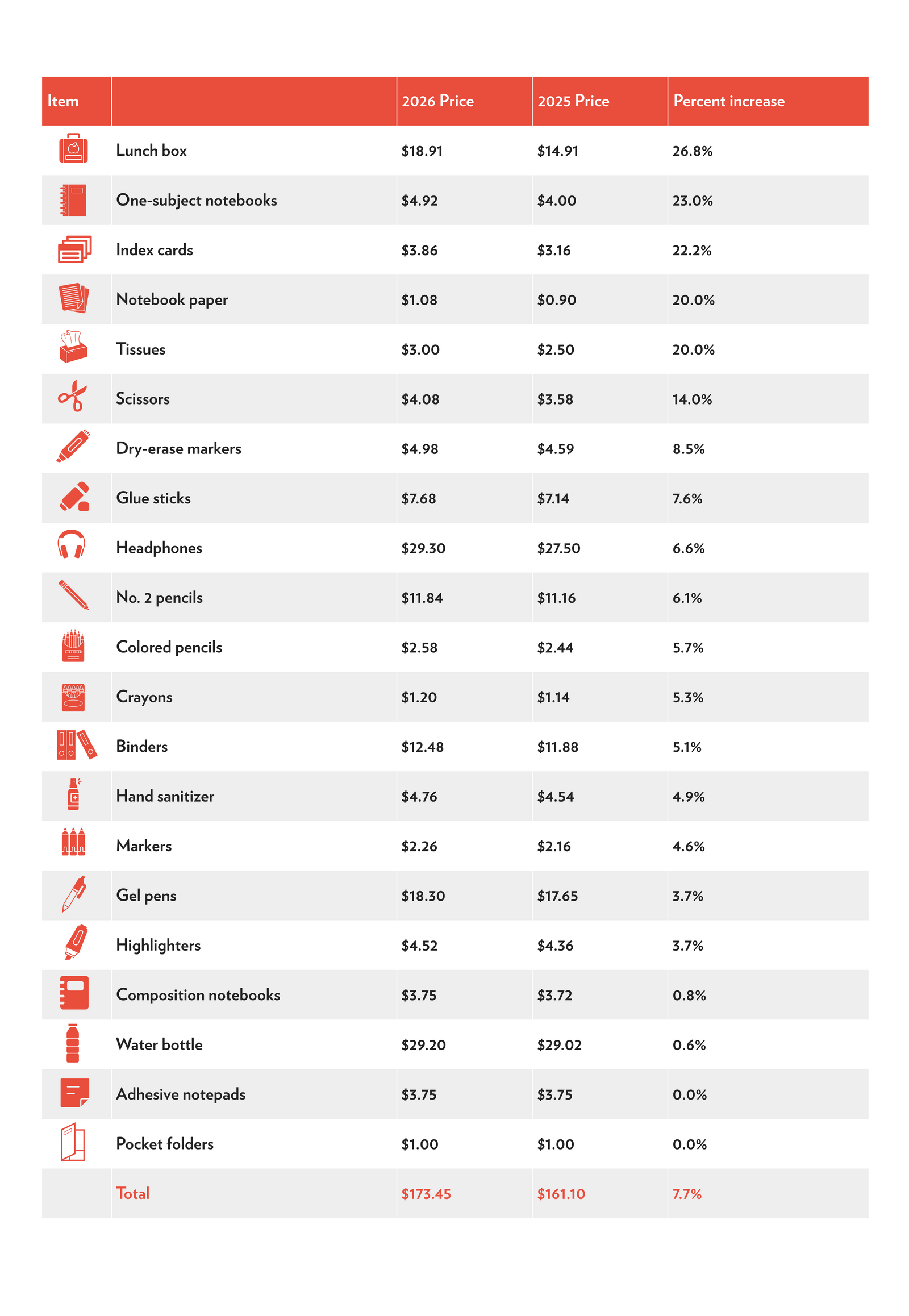
Cleveland families are heading into back-to-school season facing a budget crunch that hits from two directions at once. School supplies cost roughly 8% more than they did a year ago — a pace more than double the broader rate of inflation. And the groceries parents pack into lunchboxes are up 11% on average, with some staples rising far faster.
The analysis, from the Groundwork Collaborative and The Century Foundation, is based on retail data from NielsenIQ and actual school supply lists provided by schools to parents at both organizations. The findings put a real price tag on pressures Cleveland families have been feeling in checkout lines all summer.
By our estimates, that means the typical family is going to pay about $4,000 for school supplies and lunches in this school yearJulie Margetta Morgan, TCF president
Two forces are driving prices higher simultaneously. The tariffs President Trump has imposed on imports — including a new slate of 10–12.5% levies on goods from 60 countries announced just last week — are hitting school supplies hard. Retailers who bought back-to-school inventory this year did so after tariffs were already in effect, meaning the full cost is being passed straight to shoppers.
Energy costs are compounding the problem. The closure of the Strait of Hormuz shipping route since the Iran conflict began in late February has sent oil prices climbing — and those costs ripple through the supply chain into the price of plastics, packaging, and transportation. That means the plastic casing on a highlighter or the wrapper on a composition notebook carries a hidden price tag driven by geopolitical events thousands of miles away.
How Key School Items Compare: 2025 vs. 2026
| Item | 2026 Avg. Price | Price Increase | |
|---|---|---|---|
| Sandwich Bread (loaf) | $4.36 | $4.36 | +21.8% |
| Box of Raisins | $3.77 | $3.77 | +4.7% |
| School Supplies (avg) | — | — | +8% |
| Lunch Staples (avg) | — | — | +11% |
| Overall Inflation Rate | — | — | ~3.5% |
Families are increasingly putting their basic expenses onto debt like credit cards or short-term loans, and so these school supply costs are really a straw that's breaking the camel's backJulie Margetta Morgan, TCF president
The price surge lands at a particularly difficult moment for Cleveland families already stretched thin. Research cited in the Groundwork/TCF analysis shows increasing numbers of American households are putting basic expenses — groceries, utilities — onto credit cards or short-term loans just to get by. Back-to-school spending adds to that pile.
Nutrition benefits that softened the blow for many families last year are also harder to access. A Center on Budget and Policy Priorities analysis found 1.5 million fewer children are receiving SNAP benefits since July 2025, when Congress approved changes that tightened eligibility requirements and added new work requirements for adults in the program.
What's Driving the Price Hikes — and What Isn't
Tariffs are behind all of the school supply price increases.
Verdict: mixed
Tariffs are a major factor — retailers are passing higher import costs directly to consumers. But rising energy prices tied to the Iran conflict and Strait of Hormuz closure are also pushing up costs for plastics, packaging, and transportation across the supply chain.
Last year's back-to-school prices already reflected tariff costs.
Verdict: mostly false
Many retailers purchased last year's back-to-school inventory before tariffs hit, shielding shoppers from the full impact in 2025. This year, all that inventory was purchased after tariffs were in effect — so the full cost is now being passed to consumers.
The Supreme Court struck down Trump's tariffs, so prices should be coming down.
Verdict: false
While the Supreme Court struck down the sweeping April 2025 tariffs, the administration has continued pursuing import duties through other legal authorities. Just last week, new 10–12.5% levies on imports from 60 countries were announced — meaning tariff pressure on school supplies continues.
SNAP cuts only affect a small number of families.
Verdict: false
A Center on Budget and Policy Priorities analysis found 1.5 million fewer children are receiving SNAP benefits since July 2025 — a significant reduction that compounds the impact of rising food prices for families who previously relied on those benefits.
How Cleveland Families Can Stretch the Back-to-School Budget
- Separate the 'big jump' items from the modest ones — Paper, index cards, and lunchboxes saw far larger price increases than pens, markers, and highlighters. Prioritize reusing or buying used versions of the high-jump items.
- Shop the staples strategically — Sandwich bread is up 21.8% — the single biggest lunch staple increase in the analysis. Consider alternatives like wraps or leftovers to reduce how often you're buying a new loaf.
- Check your SNAP eligibility if your situation changed — Congress tightened SNAP eligibility in 2025 with new work requirements. If your household income or employment situation has shifted, it's worth verifying your current eligibility status.
- Look for local back-to-school supply drives — Community supply drives — like the one Joseph Fitch III attended in Lafayette — can offset costs for high-priced items. Check with Cleveland-area schools and community organizations before buying everything retail.
- Build a one-list, two-tier shopping plan — Identify which items your child truly needs new this year versus which can be reused or substituted. As parent Shayna VanKooten put it: 'It's about knowing which things to splurge on and which to save.'
Where These Numbers Come From
The price analysis was conducted by the Groundwork Collaborative and The Century Foundation, two progressive economic policy think tanks, using retail data from NielsenIQ — a global consumer intelligence company that tracks retail and consumer purchasing data.
The specific school supplies and lunchbox products analyzed were drawn from actual supply lists that schools provided to parents at both organizations. The $4,000 annual estimate for supplies and lunches represents a typical family scenario. The Center on Budget and Policy Priorities analysis of SNAP enrollment changes is separate from the Groundwork/TCF report and uses federal program data.
Ohio's unemployment rate currently sits at 3.6% as of June 2026, below the national rate of 4.2% — but wage growth nationally has lagged behind the pace of price increases cited in this analysis.
For Cleveland families, the $4,000 annual estimate is a reminder that school costs have become a year-round budget line — not just a late-August errand. With tariffs expected to remain in place and energy prices tied to an ongoing overseas conflict, experts say there's little relief on the horizon before the school year starts.
What Cleveland families do have is information: knowing which items have surged the most, understanding what's driving those increases, and making deliberate choices about where to spend and where to save. The supply list this year is the same — the math behind it has changed significantly.
Sources & References
- Primary source: Scripps News — Jacob Gardenswartz
- Groundwork Collaborative and The Century Foundation — Analysis of school supply and lunch staple price increases, 2025–2026, using NielsenIQ retail data
- Center on Budget and Policy Priorities — Projected decline of 1.5 million children receiving SNAP benefits since July 2025 eligibility changes
- U.S. Bureau of Labor Statistics — Consumer Price Index, All Urban Consumers, June 2026