That $4,000 figure from Groundwork Collaborative and The Century Foundation isn't an outlier — it's the new normal for a typical American family covering both school supplies and lunches for the year. For Cincinnati households already managing higher grocery bills and utility costs, it's the kind of number that lands somewhere between a sigh and a spreadsheet.
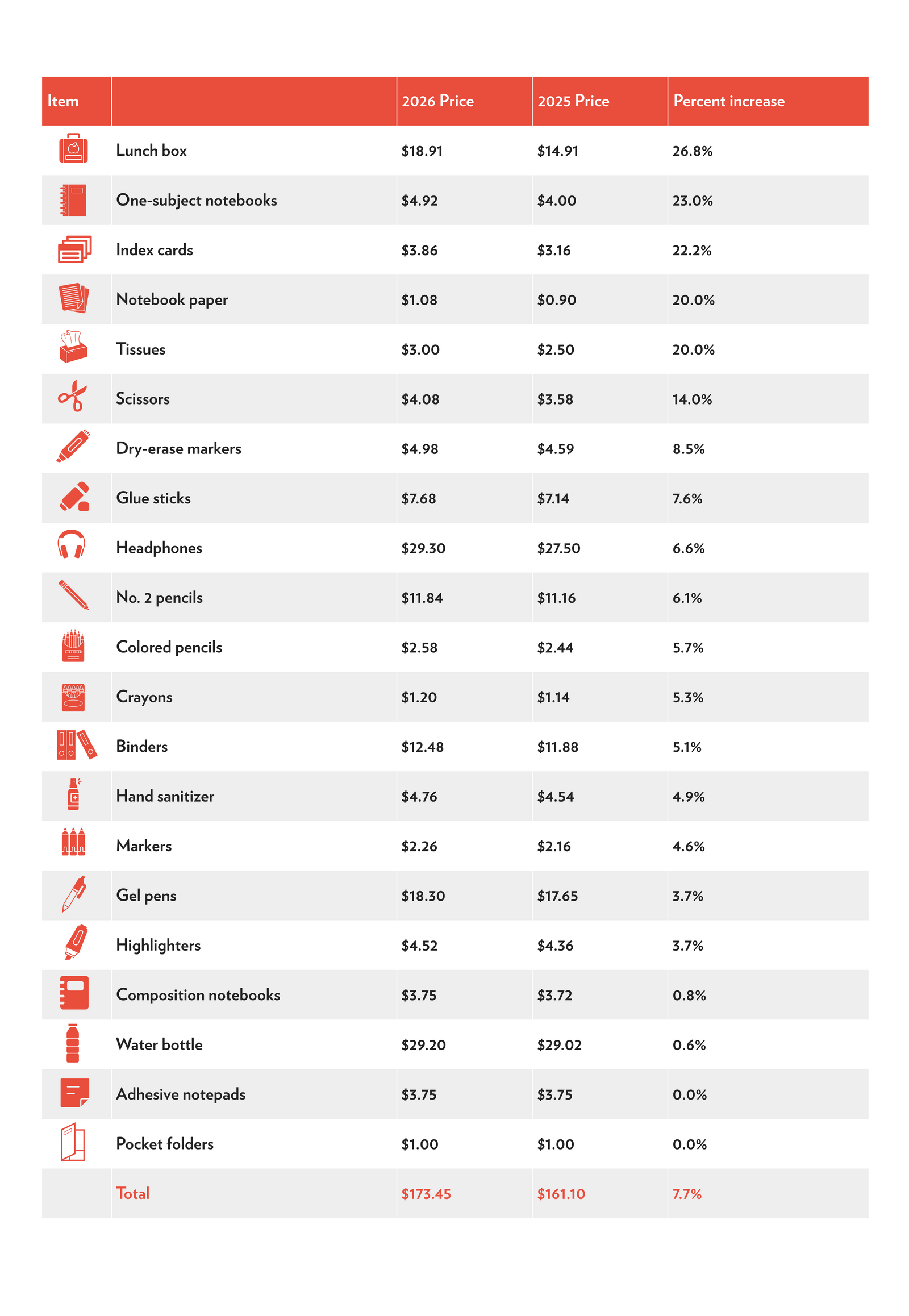
The analysis, which drew on retail data from NielsenIQ, found that while some items like highlighters, pens, and markers saw modest increases, others hit much harder. A loaf of sandwich bread is up 21.8% from last year, now averaging $4.36. A box of raisins runs about $3.77 — up 4.7%. Lunchboxes, index cards, and paper are among the steepest climbers on the supply side.
Two forces are driving the surge, according to experts at Groundwork Collaborative. The first is the ongoing conflict affecting the Strait of Hormuz shipping route, which has sent oil and gas prices climbing since late February. Those energy cost increases don't just show up at the gas pump — they filter into the plastic casing around a highlighter, the packaging on a composition notebook, and the diesel that delivers them to store shelves.
The second force is tariffs. While the sweeping import duties President Trump announced in April 2025 were later struck down by the U.S. Supreme Court, the administration has continued pursuing import levies through other legal authorities — including a new round of 10 to 12.5 percent tariffs on imports from 60 countries announced just last week. Last year, many retailers had already bought their back-to-school inventory before tariffs kicked in. This year, that buffer is gone.
The tariffs have now been in effect for quite some time, all of the school supplies that retailers and companies purchased this year are subject to those new higher tariff rates and they're passing those higher tariff rates right along to consumers.Lindsay Owen, Groundworks president and CEO
How Specific Prices Have Shifted
| Item | 2025 Avg. Price | 2026 Avg. Price | % Change | |
|---|---|---|---|---|
| Sandwich Bread (loaf) | ~$3.58 | $4.36 | +21.8% | |
| Raisins (box) | ~$3.60 | $3.77 | +4.7% | |
| Overall Supply List | Baseline | +~8% | More than 2x inflation | |
| Overall Lunch Staples | Baseline | +~11% | Avg. across lunchbox items |
The timing couldn't be harder for many Cincinnati-area families. Congressional changes to SNAP approved last year tightened eligibility and added new work requirements, and a nonpartisan analysis by the Center on Budget and Policy Priorities projects 1.5 million fewer children are now receiving benefits compared to July 2025. That means families are absorbing higher food prices with fewer nutritional safety nets than they had a year ago.
Meanwhile, data shows more American households are turning to credit cards and short-term loans to cover basic expenses like groceries and utilities. School supply season lands directly on top of that financial stress.
This is really a double whammy where families are facing rising food prices at the same time as their ability to pay for food is really eroding because they don't all have access to things like nutrition benefits that they might have had last yearLindsay Owen, Groundworks president and CEO
How Much Do You Know About What's Driving These Costs?
Four questions. Test what you just learned.
By approximately how much has the average price of a loaf of sandwich bread risen since last year?
- About 5% — The increase is much steeper than general inflation. Sandwich bread is up 21.8% from 2025, now averaging $4.36 per loaf — one of the sharpest jumps among all items analyzed.
- About 11% — Close — 11% is the average increase across all school lunch staples. But sandwich bread specifically surged much higher, up 21.8% to $4.36 per loaf.
- About 22% — Correct. Sandwich bread is up 21.8% from last year, now averaging $4.36. That's far outpacing the ~11% average increase across all lunch staples.
- About 8% — 8% is the average increase for school supplies overall. Sandwich bread specifically jumped 21.8% — one of the single steepest price increases in the entire analysis.
Why did tariffs hit back-to-school costs harder in 2026 than in 2025?
- New tariffs were announced this spring targeting school supplies specifically — The tariffs aren't school-supply specific — they're broad import duties. The key issue is timing: last year, many retailers had already bought their inventory before tariffs took effect.
- Retailers had already bought their 2025 inventory before tariffs hit — this year they couldn't — Exactly right. In 2025, many retailers had purchased back-to-school stock before tariffs took effect, shielding consumers. This year, all of that inventory was bought under the new higher tariff rates, and retailers are passing the cost on.
- The Supreme Court blocked tariff relief that was in place last year — Actually the opposite: the Supreme Court struck DOWN the sweeping April 2025 tariffs. But the administration has continued pursuing import duties through other legal authorities, including a new round of 10–12.5% levies on 60 countries.
- China began restricting exports of paper and plastic used in school supplies — The analysis doesn't cite export restrictions as a driver. The key factors are broad import tariffs — now affecting all school supply inventory retailers purchased this cycle — and energy cost increases from the Iran conflict.
How many fewer children are projected to receive SNAP benefits compared to July 2025?
- About 500,000 — The number is three times higher. The nonpartisan Center on Budget and Policy Priorities projects 1.5 million fewer children receive SNAP benefits since Congress tightened eligibility and added work requirements last year.
- About 1 million — Close but still lower than the actual projection. The Center on Budget and Policy Priorities estimates 1.5 million fewer children receive SNAP since the July 2025 program changes took effect.
- About 1.5 million — Correct. A nonpartisan analysis by the Center on Budget and Policy Priorities projected that 1.5 million fewer children receive SNAP since Congress approved changes tightening eligibility and imposing new work requirements in July 2025.
- About 3 million — The projection is 1.5 million — significant enough on its own. The Center on Budget and Policy Priorities made this estimate based on the eligibility tightening and new work requirements Congress approved in 2025.
How do energy price hikes connect to the cost of a highlighter or composition notebook?
- Classroom lighting costs get passed on to school budgets, which raise fees — That's not the mechanism described. Energy prices affect the cost of making and shipping supplies — specifically the plastic in a highlighter's casing and the packaging wrapped around a composition notebook.
- Higher oil prices raise the cost of plastic materials and transportation throughout the supply chain — Exactly. Energy price increases — tied to the closure of the Strait of Hormuz since the Iran conflict began in late February — filter through supply and transportation costs, and into raw materials like the plastic used in highlighter casings and notebook packaging.
- Factories that make school supplies run on natural gas, raising production costs — While not incorrect in general, the analysis specifically names plastic materials and packaging — not factory energy costs — as the channels through which energy price hikes affect the cost of individual school supplies.
- Schools pass higher utility bills on to parents through supply fees — The analysis focuses on retail price increases, not school-level fees. The mechanism is that oil and gas price hikes raise costs for plastic materials and transportation, which then show up in what retailers charge for each item.
What's True About This Year's Cost Surge
School supply prices are rising at roughly the same rate as overall inflation.
Verdict: false
Supply list costs are up nearly 8% this year — more than double the current rate of inflation, according to the Groundwork Collaborative and TCF analysis of NielsenIQ retail data.
The sweeping tariffs Trump announced in April 2025 are still fully in effect.
Verdict: mostly false
The U.S. Supreme Court struck down those sweeping tariffs. However, the administration has continued pursuing import duties through other legal authorities, including a new round of 10–12.5% levies on 60 countries announced just last week.
Last year's back-to-school prices were already affected by tariff costs.
Verdict: mostly false
Many retailers had already purchased their 2025 back-to-school inventory before tariffs took effect, shielding consumers last year. This year, all inventory was bought under the higher tariff rates, and those costs are being passed directly to shoppers.
Families are increasingly going into debt to cover basic living expenses.
Verdict: true
Data cited in the analysis shows increasing numbers of American families are putting basic expenses like groceries and utilities onto credit cards or short-term loans — making school supply season an added pressure on already-stretched budgets.
The Economic Context in Cincinnati
- 4.2% — National Unemployment Rate
- 3.6% — Ohio Unemployment Rate
- $4,000 — Typical Annual Supply + Lunch Bill
- 21.8% — Sandwich Bread Price Spike
How to Stretch Your Back-to-School Budget
- Audit what you already have — Before buying anything, inventory last year's backpack. Pencils, scissors, rulers, and folders often survive a full year. Lunchboxes and binders are among the items with sharper price increases this year — reusing them matters more than ever.
- Target consumables first — Index cards, paper, and composition notebooks have seen some of the steepest price jumps. Buy these in bulk if you can — and check if your school district or a community organization is hosting a supply drive that covers consumables.
- Rethink the lunch routine — With sandwich bread up 21.8% and lunch staples rising ~11% overall, packing lunch still likely beats buying — but build your lunchbox around items that haven't spiked as sharply. Raisins are up 4.7%, compared to 21.8% for bread.
- Check SNAP eligibility for your family — Congressional changes in 2025 tightened eligibility, but 1.5 million fewer children receiving benefits doesn't mean all families are ineligible. If your situation changed this year, it's worth re-checking current federal income and work-requirement thresholds.
- Know which splurges are worth it — Pens, markers, and highlighters have seen more modest increases than items like paper and lunchboxes, according to the analysis. If you have to prioritize, higher-ticket durable items may be worth the splurge — everyday consumables are where costs compound.
For Cincinnati families already navigating tighter budgets, the $4,000 annual estimate from Groundwork Collaborative and The Century Foundation is more than a data point — it's a deadline. Back-to-school shopping season arrives every August whether or not the economy cooperates, and this year the window to prepare is short.
The families facing the steepest climb are those who lost access to SNAP last year AND now face higher retail prices at the same time. It's a combination that researchers describe as a double whammy — eroding both what families can buy and what they can afford to buy it with. Cincinnati-area shoppers who are strategic about what they reuse, where they shop, and which items to prioritize will be better positioned to absorb a hit that, this year, doesn't have an easy workaround.
Take Action Before School Starts
- Find a Local School Supply Drive: Community supply drives can cover consumables like notebooks, pencils, and folders — some of the sharpest-rising items this year. Check with your child's school district or local nonprofits for dates and locations in the Cincinnati area.
- Ask for the Exact Supply List Early: Schools publish lists for a reason. Buying off-list wastes money on items that may not be needed. Request your child's list as soon as it's available and cross-reference with what you already have at home before purchasing anything.
- Avoid Putting Supplies on High-Interest Debt: With families already carrying more credit card and short-term loan debt than last year, adding school supplies to revolving debt extends the cost long past August. Where possible, plan purchases across multiple pay periods rather than charging all at once.
Sources & References
- Primary source: Scripps News — Jacob Gardenswartz
- Groundwork Collaborative and The Century Foundation — Analysis of NielsenIQ retail data on school supply and lunch staple price increases, 2025 to 2026
- Center on Budget and Policy Priorities — Projection that 1.5 million fewer children receive SNAP benefits since July 2025 eligibility changes
- U.S. Bureau of Labor Statistics — National unemployment rate 4.2%, Ohio unemployment rate 3.6%, June 2026, seasonally adjusted