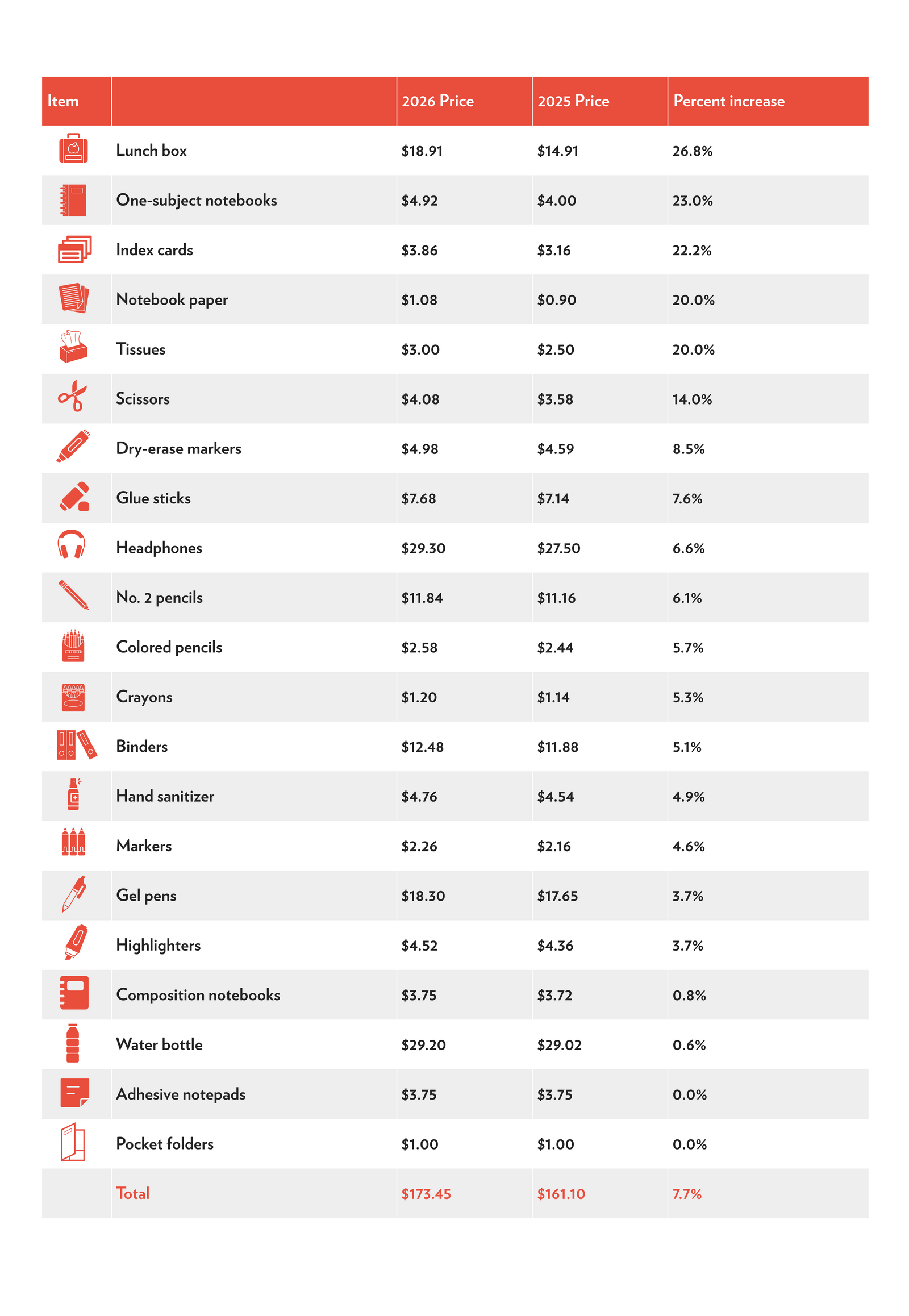
These price increases don't exist in a vacuum. Researchers say a combination of forces — the ongoing Iran conflict's impact on energy and shipping costs, and a sustained wave of import tariffs — are pushing up the cost of everything from plastic packaging on a highlighter to the cardboard wrapper on a ream of notebook paper.
While sweeping tariffs imposed in April 2025 were later struck down by the U.S. Supreme Court, the Trump administration has continued pursuing import duties through other legal channels. The result, experts say, is that retailers who loaded up on back-to-school goods before last year's tariffs are now fully exposed — and they're handing that cost directly to families.
Your Costs vs. The National Baseline
| Your Household | Typical Family (Research Estimate) | Year-Over-Year Change | |
|---|---|---|---|
| Annual Supplies + Lunches | See Your Results | $4,000 | +8–11% |
| Bread (per loaf) | Market varies | $4.36 avg | +21.8% |
| Raisins (per box) | Market varies | $3.77 avg | +4.7% |
| Overall Supply List | Based on your inputs | Up ~8% | 2x+ inflation rate |
The price surge hits hardest for families who were already counting on food assistance to stretch their budgets. Congress tightened SNAP eligibility and added new work requirements last year, and a nonpartisan analysis projects that roughly 1.5 million fewer children are receiving benefits as a result — even as grocery bills climb.
Researchers describe this as a 'double whammy': food prices going up at the same moment the safety net is being pulled back. And with wage growth trailing behind costs, more families are putting basic expenses on credit cards or short-term loans — leaving little cushion when the school year's supply list arrives.
What's Driving These Prices — and What Isn't
Tariffs from 2025 are the main reason supplies cost more this year.
Verdict: mostly true
Retailers who purchased back-to-school goods before last year's tariffs initially avoided the full impact. But this year, all goods are bought at tariff prices — and companies are passing those costs directly to consumers, per Groundwork Collaborative's analysis. New 10–12.5% levies on goods from 60 countries were announced just last week.
Inflation is the main reason school costs are rising.
Verdict: mixed
The supply price increase of nearly 8% is more than double the current rate of inflation — meaning something beyond broad CPI trends is at work. Researchers specifically point to energy price hikes from the Iran conflict and import tariffs as compounding factors on top of general inflation.
School lunch costs are rising at the same rate as supplies.
Verdict: false
Lunch staples are actually rising faster — about 11% on average versus 8% for supplies. And within lunch staples, the range is wide: raisins are up 4.7%, while sandwich bread has jumped 21.8%.
How We Got Here: The Cost Pressure Timeline
- Apr 2025 — Sweeping tariffs imposed on most nations
- Jul 2025 — Congress tightens SNAP eligibility; new work requirements take effect
- Late Feb 2026 — Iran conflict begins; Strait of Hormuz shipping route closes
- Spring 2026 — Oil and gas prices soar; energy costs filter into supply chains
- 2026 — U.S. Supreme Court strikes down broad April 2025 tariffs
- Jul 2026 — New 10–12.5% import levies announced on goods from 60 countries
- Back-to-School 2026 — Supplies up ~8%, lunch staples up ~11% vs. last year — retailers pass full tariff costs to families
How to Cut Your Back-to-School Bill
- Hit community supply drives first — Local supply drives — like the one Scripps News covered in Lafayette, LA — can provide free or subsidized essentials before you spend a dollar at retail.
- Know which items spiked most — Bread (+21.8%), index cards, and paper have seen the sharpest increases. Prioritize store brands or bulk buying for these specific items.
- Compare supply lists across grade levels — Schools distribute lists in advance. Cross-referencing siblings' lists often reveals shared items — one ream of paper can serve multiple kids.
- Recheck SNAP eligibility — Congress changed SNAP rules in July 2025. If your household previously didn't qualify or lost benefits, updated income or household circumstances may change your eligibility.
- Choose pens and markers over higher-priced alternatives — The analysis found pens, markers, and highlighters saw only modest price increases — these are the safer items to buy at full retail without as much sticker shock.
Where These Numbers Come From
The price analysis was conducted by Groundwork Collaborative and The Century Foundation — two progressive economic policy think tanks — and shared exclusively with Scripps News ahead of back-to-school season.
The researchers relied on data from NielsenIQ, a global consumer intelligence company that tracks retail and consumer purchasing. The specific products analyzed — from lunchbox staples to classroom supplies — were drawn from actual school supply lists that schools send home to parents.
The estimate that the typical family will spend about $4,000 on supplies and lunches this school year comes from TCF president Julie Margetta Morgan. The SNAP figure — 1.5 million fewer children receiving benefits since July 2025 — comes from an analysis by the nonpartisan Center on Budget and Policy Priorities.
For families like Joseph Fitch III's — six kids at home with another on the way — the math is unforgiving. Supply drives help, but they don't close an 8% gap across an entire supply list multiplied by a large household. Parents like Shayna VanKooten, who has three school-age children, say they're learning to make strategic choices: knowing which items to buy full-price and which to hunt for deals on.
That's the reality for American families this back-to-school season. The causes are structural — tariffs, energy costs, benefit cuts — and they're not disappearing by September. The $4,000 average estimate from researchers is a national baseline; for larger families or households that lost food assistance, the real number hits considerably harder.
Find Back-to-School Help in Your Area
- Community Supply Drives: Local organizations hold free school supply giveaways before the school year begins. Search your neighborhood, school district, or local nonprofit network for events near you.
- Check SNAP Eligibility: Rules changed in July 2025. If your household's income or size has changed, or if you lost benefits, your status may be different now. Contact your local benefits office or social services agency.
- Tax-Free Shopping Windows: Many states offer sales-tax holidays on school supplies and clothing before the school year. Check your state's department of revenue website for dates and eligible items.
Sources & References
- Primary source: Scripps News — Jacob Gardenswartz
- Groundwork Collaborative / The Century Foundation — Analysis of NielsenIQ data on school supply and lunch staple prices, 2025–2026 school year
- Center on Budget and Policy Priorities — Projected decline of 1.5 million children receiving SNAP since July 2025 eligibility changes
- U.S. Bureau of Labor Statistics — National unemployment rate, June 2026 (seasonally adjusted)