Is Your Family Ready for the DPS Phone Ban?
Six quick questions. Find out where your household stands before next school year hits.
How does your child currently communicate with you if they feel unsafe at school?
- They text or call me directly — Under the new DPS policy, that option disappears. You'll need to work with the school now — front office calls, a pre-arranged check-in system, or an emergency contact plan. Start that conversation with your child's principal before fall.
- Through the school office or a teacher — You're already set up for the new system. DPS Superintendent and Board President Xóchitl Gaytán have committed to improving school-to-family emergency communication as phones come out of students' hands.
- We don't really have a plan — Now's the time to build one. Talk to your child's school about emergency protocols and ask for the front office direct line. One phone call now prevents a real problem later.
- A mix — phone first, school backup — The phone option goes away. Make the school-backup your primary plan and make sure both you and your child know the protocol cold.
Does your child currently use their phone or device during the school day for translation or language support?
- Yes — they rely on it regularly — Good news: DPS is carving out exemptions for multilingual learners who depend on technology for translation. Talk to your child's teacher or case manager before next year to make sure the exemption is documented.
- Sometimes, but not as a primary tool — Worth checking with the school anyway. If there's any multilingual support need, getting it on record before the ban takes effect protects your child's access.
- No — not a factor for us — No issue here. The exemption process won't apply to your household, so the general ban applies from day one.
How does your child manage their school schedule, homework reminders, and assignments right now?
- Mostly on their personal phone — This habit needs a reboot before fall. A paper planner or school-issued device can fill the gap — but the transition takes practice. Start over the summer so it's not a shock on day one.
- On a school-issued device or paper — School-issued devices and paper planners are not covered by the ban — only personally owned devices. Your child's workflow should be largely unaffected.
- A mix of personal phone and school tools — Worth shifting toward school tools now. The personal phone won't be available during the day to check reminders or look up assignments.
- Honestly, I'm not sure — Ask them this week. You want to know how they track homework before the ban takes effect — not after the first missed assignment.
A Vista Academy teacher described collecting and redistributing phones every period as 'time-consuming and unnecessary.' How do you feel about your child's school handling physical phone storage all day?
- Confident — the school has it handled — DPS Superintendent will work with school administrators to finalize storage procedures before next fall. Staying in the loop as those details emerge is still worth doing.
- Curious — I want to know the specifics — Smart. The Superintendent is still working out storage logistics. Reach out to your school's principal now and ask what the plan is — your questions help shape it.
- Worried — what if the phone gets damaged or lost? — A completely fair concern. Before school starts, ask the school for their liability policy on stored devices. Consider whether a basic non-smart phone or a locker-safe case makes sense.
- Against it — I don't think schools should hold phones — Your concern is shared by many DPS parents. The Board acknowledged that emergency communication protocols need to improve as phones come out of students' pockets. Contact your school board rep to make your voice heard on the storage details.
Be honest: how often does your child use their phone during class time right now?
- Constantly — it's a real problem — The DPS ban was designed exactly for this. One DPS parent told Denver7 that phones are 'extremely distracting' and that teachers shouldn't have to be classroom managers AND device monitors at the same time. This policy gives teachers their classrooms back.
- Sometimes — usually when they're bored — Even occasional phone use during class pulls attention. Research consistently shows that the mere presence of a phone on a desk — even face down — reduces cognitive performance on complex tasks.
- Rarely — they're pretty disciplined — That discipline is real, and it's worth acknowledging. The ban still applies, but your child may adapt more easily than most. Use this as an opportunity to talk about why the rule exists.
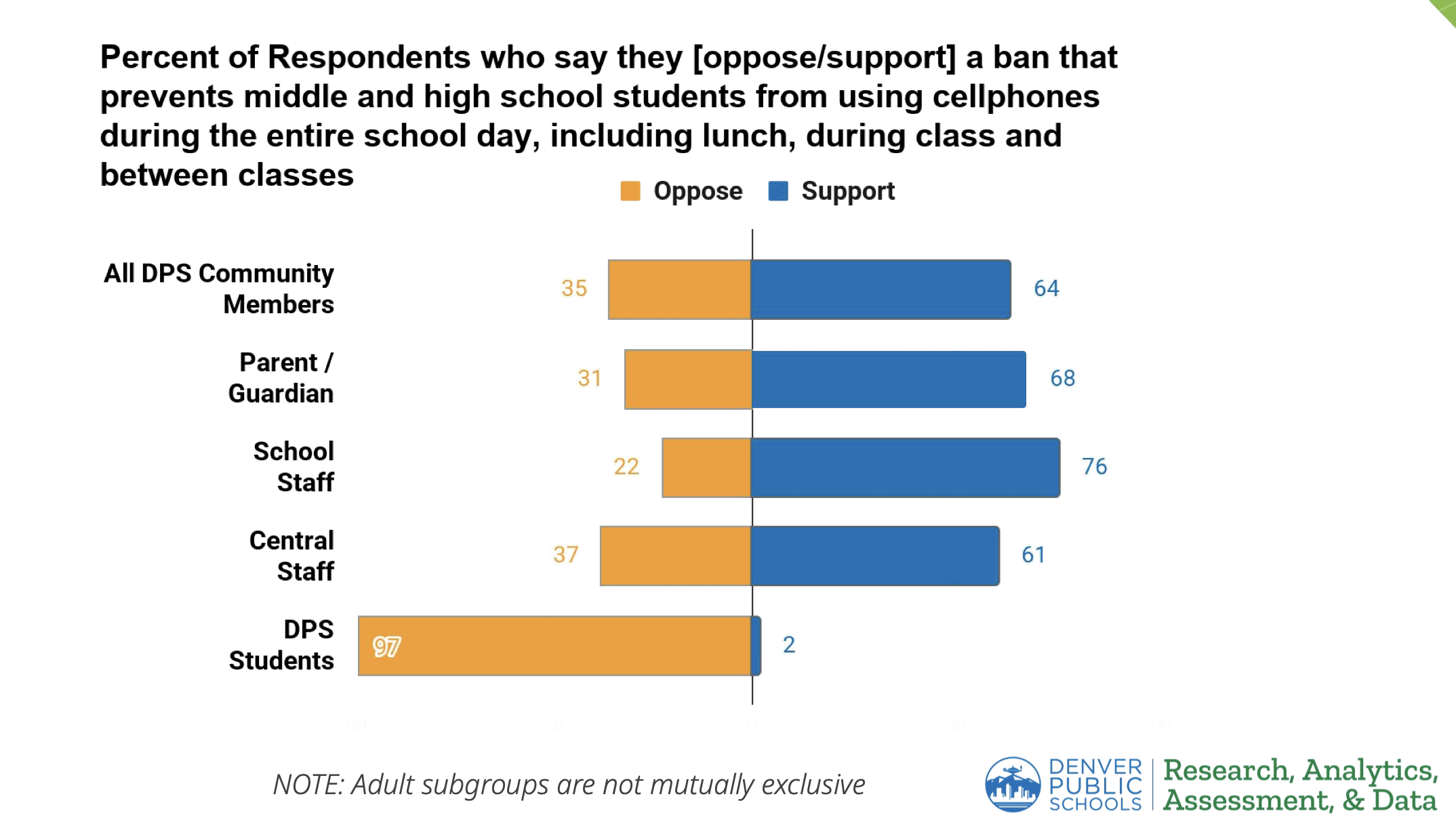
- I honestly don't know — Worth asking. DPS's own survey data suggests distraction is widespread — 64% of parents and staff backed the ban because they're seeing it firsthand. The answer might surprise you.
Have you talked to your child about what the phone ban means for their daily routine?
- Yes — we've had a real conversation — That conversation is the most important prep step. Children who understand the 'why' behind a rule are more likely to follow it — and less likely to feel blindsided when school starts.
- Sort of — I've mentioned it but not gone deep — Go deeper before fall. Talk through what they'll miss (lunch texts, music between classes, quick searches) and make a plan together. Involve them in the solution and the resistance drops.
- Not yet — I just heard about this — Now's the time. The policy is set — it passed unanimously. The more lead time your child has to adjust expectations and habits, the smoother the first week of school will be.
- They already know and they're furious — Ninety-seven percent of DPS students feel the same way. Acknowledge the frustration, then pivot to what changes for them practically — and what doesn't. Structure and empathy go a long way here.
The vote was unanimous — every single DPS board member said yes. That kind of consensus is rare, and it signals how seriously district leadership takes the issue. Teachers have been asking for this for years. Vista Academy special education teacher Dr. Maria Falcón, who works with 6th through 12th graders, put it plainly: collecting and redistributing phones every single period is a time drain that pulls everyone away from learning. An all-day policy eliminates that friction entirely.
But the families most affected aren't talking about pedagogy — they're talking about safety. DPS parent Tamika Galloway told Denver7 she's relied on her kids calling her directly during perceived threats at school, and those threats turned out to be real. That's the tension at the heart of this policy: what's gained in focus may feel like a loss in real-time connection. DPS Board President Xóchitl Gaytán acknowledged it directly — the Superintendent will need to build a stronger emergency communication pipeline between schools and families before next fall.
What Changes Under the DPS Phone Ban
Current Policy
- Varies Phone rules by school Each campus set its own norms
- Students could text parents during passing periods or lunch
- Personal earbuds used in some classrooms
- Smartwatches generally allowed
- Personal tablets sometimes permitted
Starting Next School Year
- All Day District-wide ban First bell to last bell, every school
- No student-to-parent texting during school hours
- No wireless earbuds on campus during school day
- No smartwatches or electronic watches
- Exemptions for multilingual learners' translation needs
What gets banned is sweeping: personal phones, smart and electronic watches, wireless earbuds, personal tablets, personal laptops, and any other portable electronic communication device a student owns. School-issued devices are a separate matter — those are under district control and not affected by the personal device policy. The Superintendent still has work to do before September, including finalizing how and where phones will be stored during the school day, and building out the emergency communication protocols that parents like Galloway are demanding.
How DPS Stacks Up: Phone Policy Approaches Across Colorado
| DPS (New Policy) | Class-Only Ban | No Policy | |
|---|---|---|---|
| Phones allowed during lunch | No | Yes | Yes |
| Phones allowed during passing periods | No | Yes | Yes |
| Teacher collection required each class | No — stored once at start | Yes — every period | No — not enforced |
| Exemptions available | Yes — multilingual learners | Varies | N/A |
| Parent survey before vote | Yes — 64% support | Rarely | No |
| State law compliance | Full | Partial | Non-compliant |
I think it's going to afford the kids focus, better mental health, success in their studies, and better peer-to-peer connection.Jamie Chesser, DPS parent of a 6th grader
What's True — and What's More Complicated
Students will have no way to contact parents in an emergency.
Verdict: mostly false
The policy doesn't eliminate emergency communication — it shifts it. School offices remain fully operational. DPS Board President Gaytán specifically committed to improving school-to-family emergency notification systems as part of the policy rollout. Students can always reach the front office.
The ban covers every single electronic device a student owns.
Verdict: mostly true
The policy is broad: phones, smartwatches, earbuds, personal tablets, personal laptops. However, the Superintendent is carving out exemptions for multilingual learners who rely on devices for translation support. School-issued devices are not affected.
Most DPS families wanted this ban.
Verdict: mixed
64% of survey respondents — parents, staff, and students combined — supported the all-day ban. But that number masks a dramatic split: 97% of students opposed it. The majority support comes primarily from adults, not the students most directly affected.
Teachers will have to collect phones at the start of every class period.
Verdict: false
The all-day ban was actually chosen BECAUSE it eliminates the per-period collection process. Dr. Falcón at Vista Academy told Denver7 that collecting and handing back phones every class is exactly the logistical burden a full-day policy avoids. Students store devices once — at the start of the school day.
What DPS Families Should Do Before Next School Year
- Build an emergency contact plan with your child — Identify the school's direct office line and program it into your phone. Walk your child through exactly what to do and who to tell if they feel unsafe. Practice it once before school starts.
- Check if your child qualifies for a multilingual exemption — If your child relies on a device for translation or language support, contact their teacher or special education case manager before the school year begins to get the exemption formally documented.
- Replace phone-based homework habits with school tools — If your child tracks assignments or receives reminders on their personal phone, spend a few weeks this summer transitioning them to a paper planner or school-issued device. Don't wait until the first Monday of school.
- Ask your school about the physical storage plan — The DPS Superintendent is still finalizing how and where phones will be stored during the day. Email your principal before fall to ask about liability for lost or damaged devices and what storage will look like.
- Have an honest conversation with your student — Ninety-seven percent of students opposed this ban. Acknowledge that frustration directly, then talk through what changes and what doesn't. Kids who understand the reasoning — and feel heard — adapt faster.
The DPS phone ban isn't the end of the conversation — it's the beginning of a new logistics challenge for every school in the district. The details that matter most to families (Where exactly does the phone go? What happens if it's damaged? How does my kid reach me during a real emergency?) are still being worked out by the Superintendent before next fall. That's not a knock on the policy — it's the reality of implementing a district-wide change affecting tens of thousands of students at once.
What the vote does make clear is that DPS adults — parents, teachers, staff, and board members — see phone distraction as a serious enough problem to act decisively. The research increasingly backs them up: smartphone access during the school day is linked to lower academic performance and higher anxiety in adolescents. Denver's students may be frustrated right now, but the district is betting that a focused, connected school day is worth the adjustment.
What Denver Families Need to Know Right Now
- Policy Takes Effect Next School Year: The all-day ban begins with the 2026–27 school year. Exact storage procedures will be finalized by the Superintendent before fall.
- Multilingual Learner Exemptions Available: Students who rely on devices for translation must have the exemption documented before school starts. Contact your child's teacher or case manager now.
- Emergency Communication Is Changing: The school front office is your new first call. Get the direct office line for your child's school and save it before September.
- Questions? Contact Your School Board Rep: Storage details, liability questions, and emergency protocols are still being finalized. Your input shapes how the policy gets implemented.
The State Law Behind the Ban
The DPS policy didn't emerge from a vacuum — it was required. Colorado passed a state law mandating that every school district adopt a policy on student device use during the school day by July 1, 2026. Districts had flexibility in how strict to make their policies, but doing nothing was no longer an option.
DPS chose the most comprehensive approach available: an all-day ban rather than a class-only restriction. The district surveyed parents, staff, and students in May to gauge community sentiment before drafting the policy. The 64% support among adults — combined with unanimous board approval — gave the district the political cover to go further than a more limited policy might have.
Other Colorado districts are making their own calls under the same deadline. Some are opting for class-only bans; others are mirroring DPS's all-day approach. The state law doesn't prescribe a single model — it just requires that a policy exist and be enforced.
Sources & References
- Primary source: local-news — Maggie Bryan
- Denver7 / Denver Public Schools — DPS Board of Education unanimous vote on all-day phone ban; survey data showing 64% adult support and 97% student opposition
- Colorado General Assembly — State law requiring Colorado school districts to adopt a student device use policy by July 1, 2026
- Denver Public Schools — DPS policy text covering banned devices: personal phones, smartwatches, wireless earbuds, personal tablets, personal laptops, and other portable electronic communication devices; multilingual learner exemptions
- Journal of the Association for Consumer Research — Research on smartphone presence during class reducing cognitive performance even when devices are face-down ('brain drain' effect)