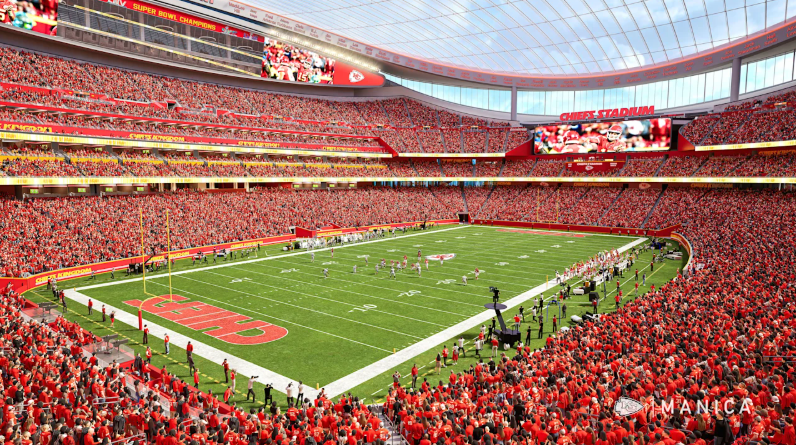
This is not just a building — it's a state-line crossing. The Chiefs have called Arrowhead Stadium in Missouri home for decades. Now, under a deal struck with Kansas officials last December, the franchise is moving across the border to Kansas City, Kansas, backed by a public-private partnership funded through Sales Tax and Revenue Bonds and a fund called the Attracting Professional Sports to Kansas Fund.
The move comes with a second major project: a new $300 million team headquarters and practice facility, also part of the agreement. Together, the two projects represent a seismic shift in where one of the NFL's most successful franchises plants its flag.
The roof is one of the stadium's most talked-about engineering features. The 400,000-square-foot ETFE — a lightweight, translucent fluoropolymer film — has already been used on major stadium projects in Minneapolis, Los Angeles, and Las Vegas. Critically for Chiefs faithful, the translucent panels mean military flyovers — a hallowed Arrowhead game-day tradition — will still be visible from inside the new dome.
Design firm MANICA, headquartered in Kansas City, Kansas, is leading the look and feel of the project. HNTB serves as architect of record. Both were selected after a months-long vetting process. MANICA President David Manica described the mission plainly: honor Arrowhead's legacy while boldly reimagining its future — not just for today's fans, but for the generations of Chiefs Kingdom to come.
Old Home vs. New Home: Arrowhead vs. the Kansas City Dome
| Arrowhead Stadium | New KC Dome | |
|---|---|---|
| Location | Kansas City, Missouri | Kansas City, Kansas |
| Roof | Open air | 400,000 sq ft ETFE dome |
| Capacity | 76,416 (current) | ~70,000 (estimated) |
| Parking | Not specified in announcement | 20,000+ spots |
| Military Flyovers | Yes — open air | Yes — translucent roof |
| Design Firms | Original: HOK Sport | MANICA + HNTB |
| Project Cost | Original build era cost | $3 billion |
| Lamar Hunt Statue | Existing tribute | New statue in modern plaza |
How Much Do You Know About the New Chiefs Stadium?
Four questions. Test what you picked up from the announcement.
Which roofing technology will cover the new Chiefs dome — and where else has it been used?
- Steel and glass — also used in Dallas and Houston — Not quite. Dallas and Houston weren't cited. The roof uses ETFE panels — a translucent film technology also deployed in Minneapolis, Los Angeles, and Las Vegas.
- ETFE panels — also used in Minneapolis, Los Angeles, and Las Vegas — Exactly right. The 400,000-square-foot ETFE roof is a lightweight, translucent technology that allows military flyovers to remain visible — one of the most discussed design details in the announcement.
- Retractable fabric — similar to Mercedes-Benz Stadium in Atlanta — Atlanta wasn't mentioned. The Chiefs chose ETFE panels, which are already proven on three other NFL-market stadium projects: Minneapolis, Los Angeles, and Las Vegas.
- Polycarbonate sheets — a new technology not used in professional sports before — This technology wasn't referenced. ETFE is the answer — and it's far from new, already covering major venues in Minneapolis, Los Angeles, and Las Vegas.
What was the key reason the Chiefs' design team prioritized the shape of the stadium bowl?
- To maximize television camera angles for broadcast — Broadcast angles weren't cited as the driver. The bowl shape was chosen to honor the legacy of Arrowhead Stadium — and the entire design was studied by audio engineers to maximize crowd noise.
- To honor Arrowhead Stadium's shape and maximize crowd noise — Right. Clark Hunt said the building 'will be built for noise.' Audio engineers studied the design, and MANICA described the bowl shape as a direct nod to Arrowhead's unmatched energy and tradition.
- To accommodate a larger capacity than the current Arrowhead record — Actually, the new dome's estimated 70,000-seat capacity is slightly smaller than Arrowhead's current capacity. The bowl shape decision was about noise engineering and honoring legacy — not expansion.
- To reduce construction costs by using a simpler structural frame — Cost reduction wasn't the stated rationale. The bowl mirrors Arrowhead intentionally — and it was shaped by audio engineers to make the new dome as loud as possible on game day.
How is the new stadium being funded?
- Entirely by the Chiefs organization with no public money — Not the case. The project uses a public-private partnership — Kansas issued Sales Tax and Revenue Bonds, and the state's Attracting Professional Sports to Kansas Fund contributed to the deal.
- A public-private partnership including Kansas Sales Tax and Revenue Bonds and the Attracting Professional Sports to Kansas Fund — Correct. Kansas structured the deal specifically to attract the Chiefs — both the $3 billion stadium and the $300 million practice facility are part of that cross-state-line agreement.
- A federal infrastructure grant combined with city of Kansas City bond financing — Federal grants weren't mentioned. The funding mechanism is a Kansas state-level public-private partnership: Sales Tax and Revenue Bonds plus the Attracting Professional Sports to Kansas Fund.
- NFL revenue sharing supplemented by Missouri and Kansas jointly — Missouri isn't part of the funding structure — the Chiefs are leaving Missouri. Kansas is the funding partner, using state-issued bonds and a purpose-built sports attraction fund.
Beyond the stadium itself, what else is being built as part of the Chiefs' move to Kansas?
- A $300 million team headquarters and practice facility — Right. The Kansas agreement includes a separate $300 million team headquarters and practice facility — plus plans for mixed-use development outside the stadium, including a larger Chiefs Hall of Honor and team store.
- A $150 million youth sports complex open to the public — A youth complex wasn't part of the announced plan. The second major project is a $300 million team headquarters and practice facility, alongside mixed-use development on the stadium site.
- A new light rail line connecting the stadium to downtown Kansas City — Transit infrastructure wasn't announced as part of the project. What was confirmed: a $300 million practice facility and HQ, plus a mixed-use development zone outside the stadium.
- An expanded Arrowhead Stadium renovation in Missouri — The Chiefs are leaving Missouri — Arrowhead renovation is off the table for this project. The new construction is entirely in Kansas: the dome, a $300 million practice facility, and surrounding development.
Outside the bowl, the new stadium is designed to be a destination — not just a game-day stop. Plans call for a Drum Deck for pregame and in-game events, a modern plaza anchored by a Lamar Hunt statue honoring the franchise's founding father, and a larger Chiefs Hall of Honor alongside an expanded team store. A mixed-use development district surrounds the entire complex, turning the site into a year-round community draw.
That vision — a stadium as neighborhood anchor — reflects where major sports development is heading across the country. The Chiefs are betting that the energy of Chiefs Kingdom, transplanted from Missouri to Kansas, can power something bigger than football. The new dome is designed, as HNTB's Tom O'Grady put it, to become 'an enduring landmark for generations of fans' — and for the city that's now calling it home.