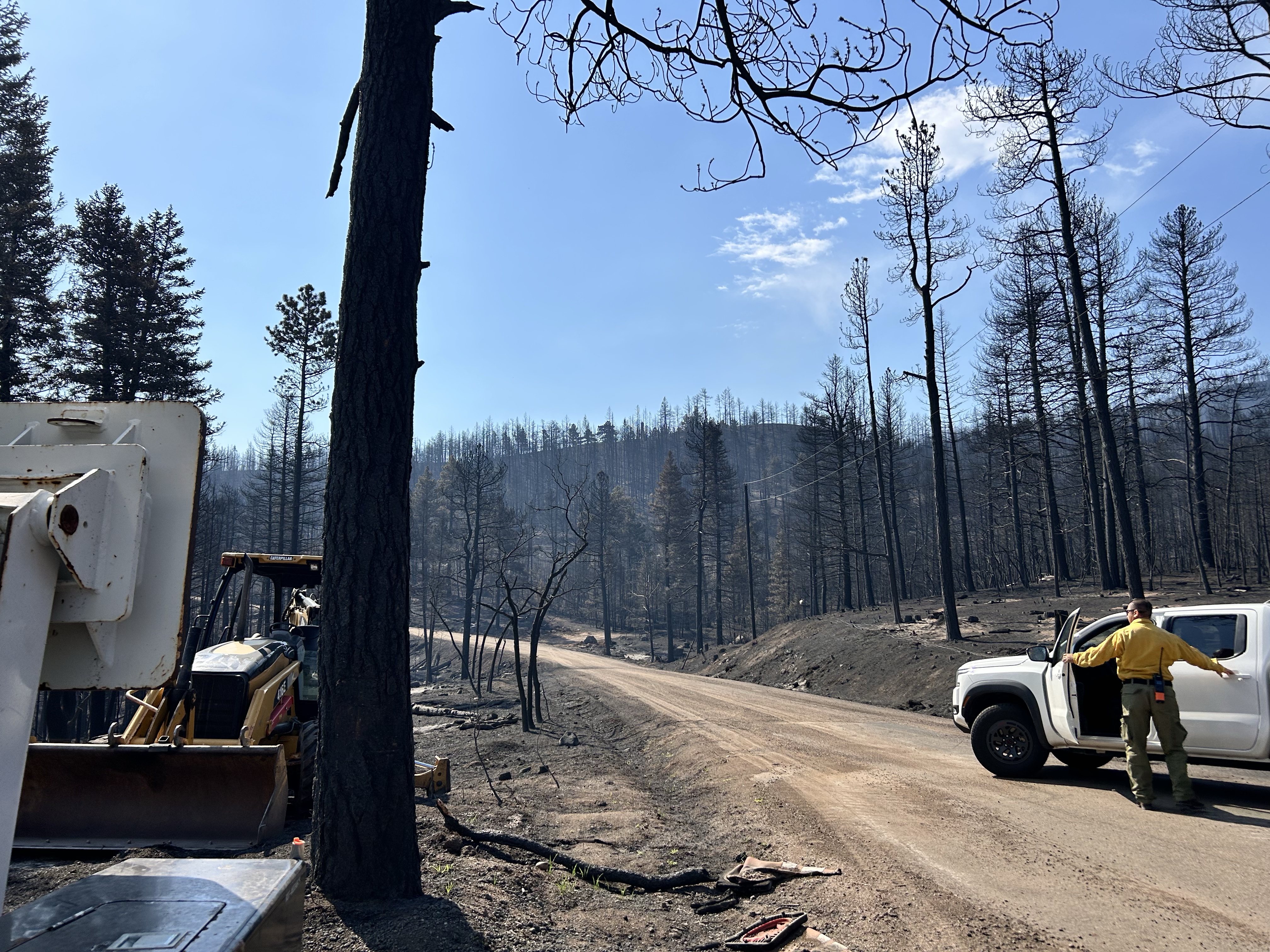
On the morning of July 10, 2026, Denver7's Veronica Acosta joined the Alaska Complex Incident Management Team #1 for a drive through what remains of Beulah. Some neighborhoods still stand. Others are gone — foundations, fence posts, and ash where homes used to be.
The fire has been burning for nearly two weeks, and officials say it could be weeks more before it's fully out. Underground roots, buried logs, and packed organic matter can smolder long after the visible flames are gone — meaning crews must constantly re-check structures even in areas that appear contained.
Among the landmarks lost is the historic Horseshoe Lodge inside Pueblo Mountain Park — a cornerstone of outdoor education and community life for generations. The Nature and Wildlife Discovery Center confirmed the loss on social media, writing that their commitment to restoration is 'unwavering' even as the full scope of damage sets in.
Pueblo County Sheriff David Lucero confirmed the lodge's destruction in late June. For a community like Beulah, where places like Pueblo Mountain Park are woven into daily identity, each loss lands like a gut punch — a phrase the fire's own public information officer used more than once.
How the Aspen Acres Fire Unfolded
- Late June 2026 — Fire encircles Beulah
- Late June 2026 — Horseshoe Lodge confirmed destroyed
- Early July 2026 — Fire crosses 100,000 acres
- Early July 2026 — Alaska Complex Incident Management Team #1 takes command
- Early July 2026 — Nearly 2,000 personnel from across the country deployed
- July 10, 2026 — Some evacuation orders begin to lift; Beulah remains evacuated
- July 10, 2026 — Denver7 tours the burn zone with incident management team
- Ongoing — Officials warn fire could smolder for weeks more
That's the scale of what Beulah's 27-person volunteer fire crew stepped into — and why their story hits differently than any statistic. Capt. Tom Laca, husband of public information officer Jill Laca, led that crew into a fire that wasn't just a job number on a dispatch board. 'It wasn't about protecting such and such address,' he told Denver7. 'It was a person whose house we were looking to protect.'
Roughly a third of those volunteers lost their own homes. They kept fighting anyway. 'They continued the fight, and they still are continuing in this fight, even though they have nothing,' Capt. Laca said.
How Well Do You Know the Aspen Acres Fire?
Four questions. The answers reveal what makes this fire unlike most.
How many structures has the Aspen Acres Fire destroyed?
- Around 200 — The destruction is far greater — officials confirmed more than 850 structures destroyed, making this one of the most damaging fires in Colorado history.
- More than 850 — Correct. More than 850 structures have been destroyed across Custer and Pueblo counties — homes, lodges, and landmarks alike.
- About 500 — Officials put the number above 850 — and that count may still be rising as crews access more of the burn zone.
- Fewer than 100 — The scale is much larger. More than 850 structures have been confirmed destroyed as of the latest official count.
Of the 27 local volunteer firefighters who battled the Aspen Acres Fire, roughly how many lost their own homes?
- None — they were kept clear of the worst areas — The opposite is true. These volunteers fought directly in their own community — and a third of them lost their homes doing so.
- About one in three — Correct. Capt. Tom Laca confirmed that approximately a third of his 27-person volunteer crew lost their homes — and they kept fighting anyway.
- Just one or two — The loss was far more widespread. About a third of the 27-person volunteer crew lost their homes — yet they remained on the line.
- All of them — About a third — not all — of the crew lost homes. Still, those who kept fighting without a home to return to were called 'heroic' by out-of-state battalion chiefs.
Why could the Aspen Acres Fire continue smoldering for weeks even after the main flames are out?
- Lack of air tanker capacity in Colorado — Air support is part of the response — but the long smolder timeline is about what's underground. Roots, duff, and logs can burn for weeks beneath the surface.
- Underground roots, duff, and logs can smolder long after surface flames die — Correct. Officials explained that organic material below the surface — roots, decomposed leaves, and buried logs — can smolder long after visible flames are gone, requiring constant re-checking of structures.
- High winds keep re-igniting spot fires — Wind is a fire risk, but the smoldering timeline officials described is specifically about underground organic matter — roots, duff, and buried logs that hold heat well below the surface.
- Water drops are not effective in mountainous terrain — Water drops are actively being used in the Beulah Valley. The long-duration risk is underground — roots, duff, and logs that smolder below the surface long after flames are suppressed.
Which historic landmark inside Pueblo Mountain Park was confirmed destroyed by the Aspen Acres Fire?
- Horseshoe Lodge — Correct. Pueblo County Sheriff David Lucero confirmed the destruction of the Horseshoe Lodge — a cornerstone of outdoor education in the region for generations.
- Beulah Valley Visitor Center — The confirmed historic loss is the Horseshoe Lodge inside Pueblo Mountain Park, confirmed destroyed by Pueblo County Sheriff David Lucero.
- Custer County Fire Tower — The confirmed landmark loss is the Horseshoe Lodge at Pueblo Mountain Park — a community anchor described as 'a cornerstone of outdoor education' for generations.
- Nature and Wildlife Discovery Center headquarters — The Nature and Wildlife Discovery Center is still operating and working on restoration plans. The confirmed historic loss is the Horseshoe Lodge inside Pueblo Mountain Park.
Beulah's Fire Response: Local vs. National Scale
| Beulah Volunteers | National Deployment | |
|---|---|---|
| Firefighters | 27 volunteers | ~2,000 personnel total |
| Personal stake | 1 in 3 lost their home | Deployed from across the country |
| Command structure | Beulah Fire Protection & Ambulance District | Alaska Complex Incident Management Team #1 |
| Out-of-state support | Received crews from across U.S. | Ventura County Fire Department among contributors |
| Current status | Still on the line | Still on the line |
What's True About Large Wildfires Like This One
Once the flames are out, the fire is over.
Verdict: false
Officials with the Alaska Complex Incident Management Team said it could be weeks before the Aspen Acres Fire is fully extinguished. Underground roots, duff, and logs can smolder long after visible flames die — and crews must continuously re-check structures to prevent rekindling.
A fire this size requires resources beyond any single community.
Verdict: true
Nearly 2,000 personnel from across the country have been deployed to battle the Aspen Acres Fire. Beulah's own 27-person volunteer crew — however heroic — needed and received massive outside support to manage a 100,000-acre blaze.
Water availability is not a limiting factor in fighting mountain fires.
Verdict: false
Battalion Chief Trevor Johnson of the Ventura County Fire Department specifically cited drought and limited available water as a challenge. 'The water and the state of drought or lack of water here in the summertime, it's hard,' he told Denver7. Crews rely on available bodies of water for drops.
Whatever your connection to Beulah — evacuee, visitor, or someone following from Denver — the fire's footprint is impossible to ignore. At 100,000 acres across two counties, the Aspen Acres Fire has reshaped a landscape that generations of Coloradans hiked, camped, and called home.
The Nature and Wildlife Discovery Center put it plainly: 'Pueblo Mountain Park has been a cornerstone of outdoor education and community connection for generations.' The road to restoring that — the trails, the lodge, the mountain town identity — will be measured in years, not weeks. But as Capt. Laca's crew proves, the people of Beulah are not waiting to start.
Follow the Aspen Acres Fire
- Denver7 Wildfire Tracker: Denver7 is tracking every update on the Aspen Acres Fire — acreage, evacuations, and road closures — as conditions change.
- Nature & Wildlife Discovery Center: The center is working with partners on restoration, safety, and long-term stewardship of Pueblo Mountain Park following the fire.
- Evacuation Status: Some evacuation orders in Custer and Pueblo counties have begun to lift. Beulah remains under evacuation as of July 10, 2026. Check with Pueblo County for the latest order status.